


Place is security, space is freedom. — Yi-Fu Tuan
Starfleet Log, Delta Quadrant—Classified Briefing
At the edge of the known, maps fail and instincts take over. We don’t just explore new worlds—we build places to survive them. Because in deep space, meaning isn’t found. It’s made.
The Delta Quadrant is a distant region of the galaxy in the Star Trek universe—vast, largely uncharted, and filled with anomalies, dangers, and promise. It is where the map ends and the unknown begins. No stations, no alliances, no history—just possibility.
And yet, possibility alone is not navigable. No one truly explores a void. We only explore what we can orient ourselves within. That is why every journey into the Delta Quadrant begins not with motion, but with homebuilding—the act of constructing something steady enough to make movement meaningful.
This is not a story about frontiers. It is a story about interruptions.
To build a home is to interrupt space.
To be born is to interrupt infinity.
Consciousness does not arise gently. It asserts. It carves. It says: Here I am. The conditions of your birth—your geography, your culture, your body—are not mere facts. They are prenotions: early constraints that allow orientation. They interrupt the blur of everything into something—a horizon, a doorway, a room.
Francis Bacon wrote that memory without direction is indistinguishable from wandering. We do not remember freely; we remember through structures. We do not live in space; we live through place. Philosopher Kei Kreutler expands this insight: artificial memory—our rituals, stories, and technologies—is not a container for infinity. It is a deliberate break in its surface, a scaffolding that lets us navigate the unknown.

Like stars against the black, places puncture the undifferentiated vastness of space. They do not merely protect us from chaos; they make chaos legible. Before GPS, before modern maps, people made stars into stories and stories into guides. Giordano Bruno, working in the Hermetic tradition, saw constellations as talismans—anchoring points in a metaphysical sky. In India, astronomy and astrology were entwined, and the nakshatras—lunar mansions—offered symbolic footholds in the night’s uncertainties. These were not just beliefs. They were early technologies of place-making.
Without a place, you are not lost—you are not yet anywhere.
And so, to explore the Delta Quadrant—to explore anything—we must first give it a place to begin.
Not just a structure, but a home.
Not just shelter, but meaning.
To understand why we need homes in the Delta Quadrant, we must first understand what it means to be in any space at all. Not merely to pass through it, but to experience it, name it, shape it—to transform the ungraspable into something known, and eventually, something lived.
This section traces that transformation. It begins with space—untouched, undefined—and follows its conversion into place, where identity, memory, and meaning can take root. Along the way, we consider the roles of perception, language, and tools—not just as instruments of survival, but as the very mechanisms by which reality becomes navigable.
We begin where we always do: in the unmarked vastness.
Space surrounds us, yet refuses to meet our gaze. It is not a substance but a condition—timeless, uncaring, and full of potential. It offers no direction, holds no memory. Nothing in it insists on being noticed. Space simply waits.
Henri Lefebvre helps us make our first move toward legibility. He proposes that all space emerges through a triad: the representations of space—the conceptual abstractions of cartographers, economists, and urban planners; the spatial practices of everyday life—our habits of movement and arrangement; and representational spaces—the dreamlike, lived realities saturated with memory, symbol, and emotion. Yet in modernity, it is the first of these—abstract space—that dominates. Space is planned, capitalized, monetized. It becomes grid and zone, not story or sanctuary.
Still, even this mapped and monetized space is not truly empty. Doreen Massey reminds us that space is not inert. It is relational, always in flux, co-constituted by those who traverse it. Space may not hold memories, but it does hold tensions. A room shifts depending on who enters it. A street corner lives differently for each passerby. What appears static from orbit is endlessly alive on foot.
We might then say: space is not blank—it is waiting. It is the stage before the script, the forest before the trail, the soundscape before the melody. It is possibility without orientation.
And yet, we cannot live on possibility. To dwell requires more than openness. Something must be placed. Something must be remembered.
Place begins when space is interrupted—when the unformed becomes familiar, when pattern gathers, when time slows down enough to matter. Where space is potential, place is presence.
Yi-Fu Tuan called place “an ordered world of meaning.” This ordering is not merely logical—it is affective, mnemonic, embodied. Place is not only where something happens; it is where something sticks. The repeated use of a corner, the ritual return to a path, the naming of a room—all of these actions layer memory upon memory until a once-anonymous space becomes deeply, even invisibly, ours.
Edward Casey expands this view by proposing that place is not a passive container of identity, but a generator of it. Who we are emerges from where we are. The self is not constructed in a vacuum, but shaped by kitchens and classrooms, alleyways and attics. A place is a crucible for becoming.
And places are not necessarily large or fixed. Often they are forged in fragments—through a method of thought called parataxis, the act of placing things side by side without hierarchy or explanation. Plates, tables, menus—listed without commentary—already conjure a restaurant. North is the river, east is the village: already we are somewhere. This act of spatial poetry, what might be called topopoetics, allows us to construct coherence from adjacency. A place need not be explained to be felt.
Moreover, places are not isolated islands. They are defined as much by what they touch as by what they contain. A healthcare startup, for instance, is not merely a business plan or a piece of code—it is a bounded intersection of regulation, culture, user need, and infrastructural possibility. Its identity as a place emerges through tension, not through self-sufficiency.
To make a place, then, is to draw a boundary—not always of stone, but always of meaning. And once there is a boundary, there is the possibility of crossing it.
If place is what interrupts space, exploration is the means by which that interruption unfolds. We explore to understand, to locate, to claim. But we also explore to survive. In an unmarked world, movement without orientation is not freedom—it is drift.
The act of exploration is always mediated by tools—technologies, heuristics, protocols, even rituals. A tool transforms a space into something workable, sometimes by revealing it, sometimes by resisting it. The ax makes the forest navigable. The microscope transforms skin into data. A recipe, too, is a tool: it arranges the chaos of the kitchen into a legible field of options.
Skill determines the fidelity of this transformation. A novice with a saw sees wood; a carpenter sees potential. A goldsmith with pliers explores more in an inch of metal than a layman can in a bar of gold. Tools extend reach, but skill gives them resonance.
Rules of thumb emerge here as quietly powerful. They encode accumulated wisdom without demanding full explanation. A rule of thumb is a kind of portable place—a local memory that survives relocation. It allows someone to move meaningfully through new terrain without starting from nothing.
But perhaps the oldest, and most powerful, tool of place-making is language. To name something is to summon it into experience. A name makes the unspeakable speakable, the abstract navigable. Storytelling is not merely entertainment—it is cartography. Myth and memory alike help us place ourselves. Rituals, in this light, become recurring acts of alignment: a way to rhythmically convert time and action into a felt geography.
In early computer games like Zork, entire worlds were constructed out of pure language. “To the west is a locked door.” “To the north, a forest.” With no images at all, a mental geography emerged. Place formed from syntax. And in open-world games, which promise limitless exploration, boundaries remain—defined not by terrain, but by tools and capabilities. One may see a mountain, but until one has a grappling hook, the mountain is not truly in reach.
This is the double truth of exploration: it reveals, but also restricts. Every tool has affordances and blind spots. Every method of navigation makes some routes legible and others obscure.
And so, just as place makes meaning possible, it also makes power visible. When we explore, we choose where to go—but also where not to go. When we name, we choose what to name—and what to leave unnamed. With each act of orientation, something is excluded.
This is where the ethical tensions begin.
To make a place is never a neutral act. It is always a form of imposition, a declaration that one configuration of the world will take precedence over another. Every boundary drawn reorders the field of possibility. In this sense, exploration—often romanticized as the pursuit of discovery—is inseparable from the logic of exclusion. The forest cleared for settlement, the land renamed by the cartographer, the dataset parsed by an algorithm: each gesture selects a future and discards alternatives. Place-making is not only constructive—it is also extractive.
Achille Mbembe’s concept of necropolitics offers a stark rendering of this dynamic. For Mbembe, the most fundamental expression of power is the authority to determine who may live and who must die—not just biologically, but spatially. A person denied a stable place—be it in legal terms, economic structures, or cultural recognition—is exposed to systemic vulnerability. They are rendered invisible, disposable, or subject to unending surveillance. In this framework, place becomes not a refuge but a rationed privilege, administered according to hierarchies of race, class, and citizenship. To be placeless is to be exposed to risk without recourse.
David Harvey arrives at a similar critique from a different angle. For Harvey, the production of space under capitalism is inherently uneven. Capital concentrates selectively, building infrastructure, institutions, and visibility in certain regions while leaving others disinvested, fragmented, or erased. Some places are made to flourish because they are profitable; others are sacrificed because they are not. Entire neighborhoods, cities, and ecosystems are subjected to cycles of speculative construction and abandonment. In this schema, place is commodified—not lived. It becomes a product shaped less by the needs of its inhabitants than by the imperatives of financial flows.
Even at smaller scales, the ethics of place-making hinge on who holds the authority to define what a place is and who belongs within it. The naming of a school, the zoning of a district, the design of a product interface—each involves not only inclusion, but exclusion; not only clarity, but control. The map that makes one community legible can make another invisible. Orientation, in this sense, is never free of consequence. It is always tethered to power.
If this is the cost of exploration, then the question we must ask is not simply whether to build places—but how, and for whom.
Those who create the tools through which places are made—architects, technologists, platform designers—wield a power that is both formative and silent. In shaping the conditions under which others navigate the world, they act as unseen cartographers. A navigation app determines which streets appear safe. A job platform defines whose labor is visible. A software protocol decides who is legible to the system. In each case, someone has already made a decision about what kind of world is possible.
This asymmetry between creator and user has led some to argue that ethical design requires more than usability—it requires an ethos of custodianship. The act of place-making must be informed not only by technical possibility, but by moral imagination. A well-designed place is not simply functional—it is inhabited, sustained, and responsive to the people who live within it.
Michel Foucault offers a vocabulary for this through his concept of heterotopias: places that operate under a different logic, outside the dominant spatial order. These may be institutional—cemeteries, prisons, libraries—or insurgent—subcultures, autonomous zones, speculative games. Heterotopias do not merely resist the prevailing map; they reveal that other maps are possible. They function as mirrors and distortions of the dominant world, reminding us that the spatial order is neither natural nor inevitable.
Yet even heterotopias cannot be engineered wholesale. They must be lived into being. This is the insight offered by Christopher Alexander and, more recently, Ron Wakkary in their explorations of unselfconscious design. Good places, they argue, are rarely planned top-down. Instead, they emerge from a slow dance between structure and improvisation. A fridge becomes a family bulletin board. A courtyard becomes a marketplace. A piece of software becomes an unanticipated ritual. In these cases, fit emerges not from specification but from accumulated use. Design, at its best, enables this evolution rather than constraining it.
To make a place, then, is not to finalize it. It is to initiate a relationship. The designer, the founder, the engineer—each acts as a temporary steward rather than a sovereign. The real test of their creation is not how complete it feels on launch day, but how it adapts to the people who enter it and make it their own. This is the quiet responsibility of custodianship: to create with humility, to listen after building, and to recognize that places do not succeed by force of vision alone. They succeed by making others feel, at last, that they belong.
We often think of place-making as a singular act—a line drawn, a structure raised, a tool released. But in truth, places are rarely built in one gesture. They are shaped recursively, iteratively, across layers and scales. A place is not simply made once—it is continuously remade, revised, and reinhabited. If power animates the creation of place, then care animates its persistence.
The previous section examined how place-making implicates violence and authority. This one turns inward, offering tools to see place-making not as an external imposition, but as a continuous, generative practice—one we each participate in, often unconsciously. Places are not only geopolitical or architectural. They emerge in routines, in interfaces, in sentences, in rituals. They are as present in the layout of a city as in the arrangement of a desktop or the structure of a daily habit.
Place-making, in this light, becomes fractal.
Every place, no matter how concrete or intentional, overlays a prior space. A home rests on a plot of land that once held other meanings. A software tool is coded atop prior protocols, abstractions, languages. A startup’s culture is built not from scratch, but from accumulated social assumptions, inherited metaphors, and the ghosts of previous institutions. No place begins in a vacuum. It begins by coalescing around an earlier ambiguity.
To say “it’s spaces all the way down” is not a paradox but a recognition: that all our structuring of the world rests on foundations that were once unstructured. And those, in turn, rest on others. Beneath every home is a history. Beneath every habit is a choice. Beneath every heuristic is an unspoken story of why something worked once, and perhaps still does.
This recursive layering reveals something crucial. Place is not just what we inhabit—it is what we build upon, often without seeing the full depth of what came before. When we set up a calendar system, when we define an onboarding process, when we reorganize a room or refactor code, we are engaging in acts of recursive place-making. These are not trivial gestures. They encode our assumptions about time, labor, clarity, worth. And in doing so, they scaffold the next set of moves. What feels natural is often just deeply buried infrastructure.
Much of what makes a place stable over time is not its physicality but its rhythm. What repeats is remembered. What is remembered becomes legible. Over time, the sediment of repetition builds tradition—not as nostalgia, but as a living scaffolding.
Rules of thumb are examples of such traditions, compacted into portable epistemologies. They are not universal truths, but local condensations of experience: “Measure twice, cut once.” “If it’s not a hell yes, it’s a no.” “Always leave a version that works.” These are not mere slogans. They are the crystallization of hundreds of micro-failures, carried forward in language so that others may avoid or adapt. A rule of thumb is a place you can carry in your mind—a place where you briefly borrow the perspective of others, where their past becomes your foresight.
Ethnographic engineering—the practice of living among those you design for—extends this logic. It is not enough to ask what users want; one must become a user. To understand a kitchen, you must cook. To redesign a hospital intake form, you must sit beside a nurse at the end of a long shift. Inhabitance precedes insight. It is not empathy as abstraction, but as situated knowledge. This is why the mantra “get out of the building” matters. It invites designers to enter someone else’s place—and to temporarily surrender their own.
Even the way we recover from failure carries spatial weight. In systems design, crash-only thinking proposes that recovery should not be exceptional but routine. A system should not pretend to avoid breakdown—it should assume it, and handle it gracefully. This principle translates beyond code. Our identities, too, are shaped by rupture and repair. We are the residue of what survives collapse. To rebuild after a crash is to reassert a place for oneself in the world—to refuse exile, to restart with a new contour of legibility. The self is a recursive place, constantly reformed by continuity and failure.
Not all places are made of walls or workflows. Some are conjured in thought but anchor entire worlds in practice. These are imagined places—places held in common through language, ritual, and belief—and their effects are no less material for being constructed.
Benedict Anderson’s theory of imagined communities describes the nation as precisely such a place: a social structure that exists because enough people believe in its coherence. A country is not simply a set of borders—it is a shared imagination of belonging, reinforced by rituals as small as singing an anthem or using the same postal code. These rituals do not merely express the nation—they enact it. The community persists not because everyone knows each other, but because they believe in the same structure of place.
Gaston Bachelard, writing of intimate places, adds another layer. His Poetics of Space reveals how rooms, nests, and thresholds function not just architecturally, but symbolically. A staircase is not just a connector between floors—it is a memory channel. A drawer is not just storage—it is a metaphor for secrecy. Through repeated use and emotional investment, even the smallest corners of a home can become vast interior landscapes.
Designers who ignore this symbolic dimension risk creating tools that are frictionless but placeless. A well-designed app may guide a user efficiently, but if it lacks metaphor, texture, or resonance, it will not endure. By contrast, even ephemeral tools—when shaped with care—can become anchoring places. A text editor that respects rhythm. A ritualized way of closing the day. A naming convention that makes each project feel storied rather than serialized. These are small acts, but they echo. They accumulate. They become sediment.
Recursive place-making, then, is not about grandeur. It is about fidelity. It is about recognizing that every small act of shaping the world—every pattern set, every name given, every recovery ritualized—is part of a larger unfolding. Place is not a one-time gift. It is a continuous offering.
Places don’t just emerge from space—they transform it. A well-made place doesn’t only make sense of what is; it makes new things possible. It reframes what we pay attention to, how we act, and who we become. Place is not the end of exploration—it is the start of imagination.
Each time we build a place, we alter the shape of the surrounding space. A room becomes a lab, a garage becomes a company, a notebook becomes a worldview. These shifts ripple outward. Identity follows structure. Tools reorganize desire. Suddenly what felt unreachable becomes thinkable. New directions appear.
This is why the Delta Quadrant matters. In Star Trek, it is the quadrant at the far edge of the map: unvisited, unaligned, untamed. But we all have our own Delta Quadrants—those domains where orientation fails. The new job. The new field. The social unknown. We don’t need to conquer these spaces. We need to inhabit them.
Building a home in the Delta Quadrant means giving shape to uncertainty. Not through control, but through commitment. Homes are not fortresses—they are launchpads. They anchor us without confining us. They give us somewhere to return to, so we can go further.
To build such homes is to design for possibility. It is to accept that the unknown will always outpace our frameworks, and to meet it not with fear, but with grounded generosity. Homes enable freedom not by removing constraints, but by embedding care in structure. They show us that discovery and dignity are not opposites—they are partners.
And yes, building these homes will be messy. There will be diplomacy with space jellyfish. There will be moral conundrums involving time loops and malfunctioning replicators. Someone will definitely rewire the main console so the espresso machine can detect tachyon emissions.
But we’ve seen worse. That’s the job.


Probably the cutest paper you’ll read today.
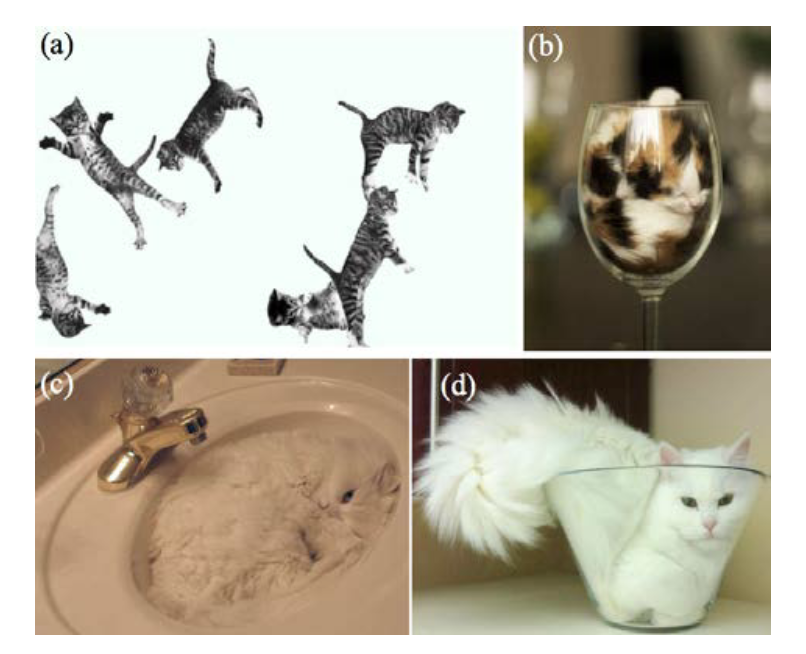
The wetting and general tribology of cats has not progressed enough to give a definitive answer to the capillary
dependence of the feline relaxation time. Fig. 2b gives
an example of a lotus effect of Felis catus, suggesting
that the substrate is superfelidaphobic. […]
cats are proving to be a rich model system for rheological research, both in the linear and nonlinear regimes.
It seems monstrosity requires an organic element. When there isn’t one, monster is more often an adjective than a noun qualifying an incomplete potential for monstrosity.
[…]
Monumentality embodies distant, impersonal forces at work, that pose a terrifying threat because they don’t care about us. Monsters on the other hand, care enough to be deliberately threatening to us.
Includes a recipe for making the perfect monster!
— Reading on contraptions.venkateshrao.com/p/monsters-and-mediocrity
There is a shared soul shard between Dwarf Fortress, Emacs, and AI that lured me to them and has kept me engaged for over a decade. For a long time, I struggled to articulate the connection, managing only to describe Dwarf Fortress as the Emacs of games. But this analogy, while compelling, doesn’t fully capture the deeper resonance these systems share. They are not merely complicated; they are complex—tools for creativity that reward immersion and exploration.
To understand the allure, let’s revise the distinction between complicated and complex. Complicated systems, say a spinning-disk microscope, consist of interlocking parts (each with internal complications) that interact in predictable ways. They require technical expertise to master, but their behavior remains largely deterministic and I tire of them soon.
Complex systems, see Cynefin framework, exhibit emergent behavior. Their value/fun lies in the generative possibilities they unlock rather than the sum of their parts.
Dwarf Fortress, Emacs, and AI live on the froth of this complexity. None of these systems exist as ends in themselves. You don’t play Dwarf Fortress to achieve a high score (there isn’t one, you eventually lose). You don’t use Emacs simply to edit text, and you don’t build AI to arrange perceptrons in aesthetically pleasing patterns. These are platforms, altars for creation. Dev environments.
Like language with the rules of poetry, these environments are generative places enabling exploration of emergent spaces. Emergence, which manifests both in the software but also in you. There is always a point where you find yourself thinking, I didn’t expect I could do that. In Dwarf Fortress first you fight against tantrum spirals and then through mastery, against FPS death. Similarly, Emacs enables workflows that evolve over time, as users build custom functions and plugins to fit their unique needs. In AI, emergence arrives rather late but it’s there. Putting together datasets, training them, optimizing, starting over, are complicated but not complex per se. The complexity (and emergence) is in the capabilities of the trained network. Things infinitely tedious or difficult are a few matrix multiplications away.
This desire for emergence is spelunking. It rewards curiosity and experimentation but demands patience and resilience. Mastery begins with small victories: making beer in Dwarf Fortress, accessing help in Emacs, or implementing a 3-layer neural network. Each success expands your imagination. The desire to do more, to push the boundaries of what’s possible, becomes an endless rabbit hole—one that is as exhilarating as it is daunting.
The high complexity of these systems—their vast degrees of freedom—opens the door to infinite creativity. This very openness, however, can be intimidating. Confronted with the sprawling interface of Emacs, the arcane scripts of Dwarf Fortress, or the mathematical abstractions of AI, it’s tempting to retreat to the familiar. Yet this initial opacity is precisely what makes these systems so rewarding. Engaging with something that might blow up in your face—whether it’s drunk cats, a lisp error, or an exploding gradient—forces you to give up.
But just then you have an idea, what you tried this…
Awaken, H. ludens.

Every few years decentralization and RSS feeds come back into the ligh. Usually this happens when one otherwise functional social media site dies in a real or practical way. Google Reader being my, and my generation’s, touchstone.
During these times of turmoil, a beautiful soul puts together a guide for how to use RSS. This is a good guide for this iteration:

I’m taking part in the Contraptions Book Club where we are reading City of Fortune which is about Venice. I was struck by the character of Doge Dandolo. Dude was 80+ when we saw a trade opportunity in the 4th Crusades. In the book, the author, Roger Crowley describes a brief moment when Dandolo makes a heroic rush on the banks of Constantinople’s Golden Horn during the Sack of Constantinople.
I found both the Doge and the imagery interesting so went looking for art depicting the art, there’s supposed to be lots. Unfortunately I couldn’t find any and nothing in the public domain. So I asked AI to generate something.
There are other paintings like the one below, but not the one I was looking for.

Came across a heartwarming fan-made comic of a collaborative story told on tumblr. A farmer makes a temple to see who shows up and it’s a self-doubting god of transient beauty. This immediately brought back the Small Gods from Discworld, but also the poem Worm by Gail Mcconnell.
The comic and the story are beautiful. Perhaps there is some sense to shrines…
via metafilter
Trying something different for a few days. Instead of spamming all the social media accounts with daily links, I will post links only on the blog everyday. Maybe even multiple times a day.
Still thinking about doing a weekly digest or something. Let’s see.

 Aneesh Sathe
