Tag: history

  • The Deep Dark Terroir of the Soul

    This is the third and final part of the Thicket Series:
    Part 1: Logic of the Thicket and the Unsearchable Web
    Part 2: The Architecture of Resistance


    The history of the working subject might be best understood not as a ledger of wages or a sequence of industrial breakthroughs, but as a study in the migration of the Master. In the eighteenth century, the Master was a concrete presence, a figure residing in the castle or the cathedral, distinct from the worker by a physical and social chasm. One knew where the authority lived because one could see the smoke from its chimneys. By the nineteenth century, this figure had moved into the factory office, closer to the rhythm of the machine but still identifiable by the suit and the watch. The twentieth century saw a further dissolution; the Master became atmospheric, blending into the very walls of the institutions that housed us—the schools, the hospitals, the barracks.

    And yet, it is in the twenty-first century that we witness the final and perhaps most unsettling migration. The Master has moved inside. It has taken up residence within the worker’s own mind, adopting the voice of the ego and the language of self-optimization. This internal migration has fundamentally altered the nature of exhaustion, shifting it from the physical depletion of the muscle to a profound infarction of the soul. To understand how we might resist such an intimate occupation, we must trace the lineage of this fatigue, moving from Voltaire’s eighteenth-century refuge of the Garden to the contemporary diagnosis of the Burnout Society, and finally, to an emerging architecture of resistance that might be called the Logic of the Thicket.

    Felsenlandschaft im Elbsandsteingebirge Caspar David Friedrich1822/1823

    The story begins in 1759, amid the wreckage of a world governed by grand, often violent, narratives. When Voltaire published Candide, the prevailing philosophical mood was one of forced optimism. Leibniz had posited that we lived in “the best of all possible worlds,” a claim that felt increasingly like a cruel joke to those living through the arbitrary brutalities of the era—the Lisbon earthquake, the Seven Years’ War, and the relentless inquisitions of both church and state. For the subject of the 1700s, the Master was external and undeniable. Life was a sequence of calamities administered from above.

    In the final pages of Candide, after a lifetime spent traversing a world of rape, slavery, and disaster in search of Leibnizian meaning, the protagonist reaches a quiet, radical conclusion. He rejects the grand debates and the lofty theorizing of his companions with a simple, grounded imperative: Il faut cultiver notre jardin—we must cultivate our garden.

    At this historical juncture, the Garden was more than a hobby; it was a strategy of containment. It served as a physical and psychological wall against a world that had grown too chaotic to manage. Voltaire suggested that simple, manual labor was the only effective shield against the primary threats of the human condition, which he identified as the Three Evils: Boredom, Vice, and Need. In the Garden, work was a form of retreat. It solved the problem of Need by providing physical sustenance—potatoes and produce—at a time when biological survival was never guaranteed. It addressed Boredom by occupying the hands and the mind with the repetitive, rhythmic care of the earth, saving the worker from the existential dread of idleness. And it warded off Vice by providing a sanctuary from the moral decay of the court and the city, replacing political intrigue with the honest friction of the soil.

    The Garden was a place of safety because it was bounded. To work was to narrow one’s world to the reach of one’s own hands, creating a small, controllable private sphere where the Master’s voice was, for a moment, silenced by the sounds of the harvest.

    However, this sanctuary could not withstand the arrival of the steam engine. As the nineteenth century progressed, the Garden was paved over by the Factory. The peasantry was pulled from the land and funneled into the burgeoning cities, where the nature of labor underwent a violent transformation. Karl Marx, observing this shift, identified the collapse of Voltaire’s dream. In the industrial setting, the worker could no longer cultivate a garden because they owned neither the seeds nor the harvest. They did not even own their own time.

    This was the era of Coercion. Marx’s diagnosis of Alienation described a worker severed from the product of their labor, from the act of production, and from their own Gattungswesen, species-essence. The Master was now the Capitalist, and exhaustion was a physical reality—a depletion of calories and muscle. Resistance, accordingly, was also physical: the strike, the riot, the seizure of the machine. The goal was to reclaim the physical Garden that had been stolen.

    As we moved into the twentieth century, the nature of control shifted again. Physical coercion, while effective, was inefficient; it bred visible resentment and the constant threat of revolution. Systemic power realized it was far more effective to train workers to police themselves. Michel Foucault described this as the Disciplinary Society, where the factory model was replicated across all social institutions. The governing logic became the Panopticon—the internalized gaze. The worker of this era was a docile body, governed by the operating verb Should. You should be on time; you should follow procedure. While the Master was becoming more abstract—a set of norms rather than a man in a tall hat—the enemy was still technically outside. There was still a door one could walk through at the end of a shift.

    The true transformation occurred at the turn of the twenty-first century, a transition captured with clinical precision by Byung-Chul Han. Han argues that the Disciplinary Society has collapsed, replaced by the Achievement Society. The modal verb has shifted from Should to Can. The demand is no longer “You must obey,” but “Yes, you can.”

    This shift has proven catastrophic for the psyche. In the old world of coercion, there was a limit; when the shift was over, the worker was, in a sense, free. But in the Achievement Society, the worker is an “entrepreneur of the self.” We are no longer exploited by an external boss so much as we exploit ourselves. We voluntarily work eighty hours a week not because of a threat of the lash, but because of a desire to “optimize” our personal brands and “reach our potential.”

    The Master has completed its migration. We carry the Panopticon in our pockets and in our egos. In this state, the Garden is no longer a retreat; it has become a performance stage. We still cultivate, but we do so frantically, documenting the process for the digital gaze, tracking our productivity metrics, and feeling a gnawing guilt that our harvest isn’t as aesthetic or impactful as our neighbor’s. The boundary between the private and the public has dissolved into a smooth, legible –searchable– surface.

    In this environment of total transparency, the Three Evils have mutated into contemporary monsters. Need is no longer about physical starvation; it has become Status Anxiety—the insatiable requirement for recognition and digital legibility. Boredom has been replaced by Hyper-Attention; we are never idle, but we are never at rest, trapped in a shallow, frantic multitasking that Han calls the “vice of the click.” And Vice itself has become Self-Exploitation—the auto-aggression of working oneself into a depression under the guise of self-fulfillment.

    By 2024, the smoothness of our digital existence had become total. Silicon Valley had successfully turned the world into a frictionless landscape where data and capital flow without resistance. Algorithms now manage the Uber driver and the freelance coder alike, using gamification to nudge behavior through a mathematical black box. We have become Tourists in a digital world built by others, wandering through clean, well-lit interfaces that prioritize searchability, SEO, above all else. If a thing is legible, it can be indexed; if it is indexed, it can be exploited.

    This brings us to the threshold of 2025 and the emerging response found in the Logic of the Thicket. If the Garden was a strategy of containment and the Factory was a site of coercion, the Thicket is a strategy of opacity.

    A thicket is not a garden. It is messy, dense, and difficult to navigate. It does not possess the neat rows or the clear boundaries of Voltaire’s refuge. Instead, it is defined by friction. To resist the smoothness of the modern Achievement Society, the worker must transition from being a Tourist to being an Explorer. The Tourist consumes intelligibility—the ease of the app, the clarity of the interface. The Explorer, by contrast, generates place through the introduction of friction.

    The Logic of the Thicket suggests that we cannot return to the eighteenth-century Garden. The walls are too brittle; databases will index the soil and an AI will recommend the fertilizer before the first seed is planted. Instead, the modern subject must create contexts that are unsearchable. This does not mean a total withdrawal from the world, but rather an engagement on terms that are too complex, too local, and too nuanced for an algorithm to easily optimize.

    We might re-examine Voltaire’s Three Evils through the lens of this new architecture to see if the Thicket offers a viable path forward.

    First, consider the evil of Need. In our current context, Need has become the fear of Irrelevance. In a smooth world, the worker is a standard, interchangeable part. If your work is legible—easy to measure and automate—you live in constant fear of economic obsolescence. This is the condition of the smooth professional: the software engineer whose code is indistinguishable from the output of a Large Language Model, the copywriter producing content that mirrors a thousand other blog posts, or the middle manager whose primary function is the transmission of standardized project plans. These roles are vulnerable because they lack friction; they offer no resistance to the efficiency of the machine.

    The Thicket addresses this through the concept of Terroir. In the culinary world, terroir refers to the specific qualities of soil, climate, and tradition that give a wine or a cheese its unreplicable character. In the world of labor, terroir is the infusion of one’s work with local context, historical depth, and human idiosyncrasy.

    For this blog, the terroir is found in the deliberate, often difficult work of communal deep-reading and historical synthesis. Here, history is not viewed as a sequence of headlines, but as a series of vast, slow-moving machines—intellectual contraptions that take centuries to build and even longer to fully start. By examining the past through this mechanical lens, the thinker begins to see the world not as a “smooth” stream of current events, but as a dense thicket of long-term trajectories.

    The process behind this blog—reading deep into difficult texts, engaging in exhaustive discussions with other thinkers, and synthesizing these influences through a deliberate collaboration with artificial intelligence—is itself a “thick” form of labor. It is a method of finalizing thought that creates a durable value, one that cannot be mimicked by a prompt-engineered shortcut. By making your work “thick”—laden with specific references, local nuances, and the friction of deep thought—you make yourself un-automatable. The machine can navigate a smooth database, but it struggles to traverse a thicket of idiosyncratic human insights that are anchored in the deep time of historical machinery. The Thicket ensures survival not by making the worker more efficient, but by making them indispensable through their unique, unsearchable “friction.”

    Next, the evil of Boredom has mutated into Passive Consumption. We are over-stimulated but spiritually idle, doom-scrolling through a world where nothing we do actually changes the environment. We are Tourists in the digital landscape, consuming the “intelligibility” of others. The Thicket solves this by demanding active navigation. In a world where algorithms predict what we want before we know it, the Thicket reintroduces the struggle of discovery. You cannot be “bored” when you are bushwhacking through a complex structure of your own making, or when you are trying to understand the slow grinding of a historical machine that began its first revolution centuries ago. The joy of the Thicket is the joy of the Explorer—the realization that the landscape is resisting you, and that you must exert agency to move through it.

    Finally, Vice has become Algorithmic Complicity—the moral laziness of letting an interface decide who we speak to, what we read, and how we spend our time. It is the vice of “disindividuation,” allowing ourselves to be smoothed down into a demographic data point. The Thicket forces a return to Virtue through Agency. To build a thicket is to refuse to be effortlessly “known.” It requires the “virtue” of privacy and the patience of shared inquiry. A “network” is smooth; you connect with a click. A “community” is a thicket; it requires negotiation, trust, and the willingness to engage with the “messiness” of other people. It requires the slow effort to inhabit a text that refuses to be summarized by an executive summary or a bulleted list.

    The journey from 1759 to 2025 is a circle that does not quite close. Voltaire’s worker fled the violence of kings into the Garden, seeking a physical retreat. Marx’s worker lost that garden and fought to reclaim the tools. Han’s worker internalized the factory, turning their own mind into a sweatshop of positivity. And the worker of 2025 now realizes that the mind itself has been mapped.

    The only remaining escape is to leave the Garden—which has become a trap of transparency—and enter the Thicket. There is a critical difference here: the Garden was intended to be safe, but the Thicket is defensive. It is a posture for a hostile territory. It saves us from Boredom by making life difficult again. It saves us from Vice by requiring conscious choice rather than algorithmic default. And it saves us from Need by ensuring we remain human enough that the machines cannot find a way to replace the specific texture of our presence.

    It is a harder path than the one Candide chose, but in a world where the Master lives in the code, it may be the only path left. The mandate for the contemporary soul is no longer simply to cultivate, but to grow something so dense and so deeply rooted that the algorithm, for all its processing power, simply cannot find the way in. We look toward the edge of the woods, not for a way out, but for a way to disappear into the depth of the growth.


    Coda: The Machinery of the Thicket

    This essay is not merely a reflection on labor; it is a byproduct of the very “Logic of the Thicket” it describes. To write it was to engage in a form of “thick” labor—a deliberate resistance to the high-speed, surface-level synthesis typical of the Achievement Society. Below is the intellectual architecture and the process that generated this piece.

    The Conceptual Bedrock

    The essay’s trajectory is built on a specific lineage of thinkers who have tracked the migration of power from the town square into the central nervous system:

    • Voltaire (Candide, 1759): Provides the initial defensive posture—the Garden. His “Three Evils” (Boredom, Vice, Need) serve as the recurring benchmarks for human exhaustion.1
    • Karl Marx: Used here to mark the collapse of the private garden. The transition from Sustenance to Alienationis the first great rupture in the history of the working subject.
    • Michel Foucault: His concept of the Disciplinary Society and the Panopticon explains how the Master became “atmospheric.” It is the era of the “Should.”
    • Byung-Chul Han (The Burnout Society): The pivotal contemporary influence. Han’s shift from the “Should” (Foucault) to the “Can” (Achievement) explains why modern exhaustion is an “infarction of the soul.”
    • Yuk Hui: His work on Technodiversity and the “recursive” nature of history informs the transition from the Tourist to the Explorer. He suggests that we cannot escape technology, but we must diversify our localrelationship to it.

    The Process: Generating “Terroir”

    The writing of this piece followed a “thick” methodology designed to avoid the “smooth” output of standard digital content:

    1. Deep Reading as Resistance: Instead of relying on summaries, the process involved “bushwhacking” through the primary texts. This creates Friction—the slow realization of meaning that cannot be automated.
    2. Mechanical Synthesis: Viewing history as a series of Slow-Moving Machines. By treating the transition from the Printing Press to the LLM as a mechanical evolution rather than just “progress,” we can see the gears of authority shifting.
    3. Collaborative Friction (AI as a Grinding Stone): Rather than using AI to generate the text, it was used as a sparring partner to test the “thickness” of the ideas. If the AI could predict the next point too easily, the point was discarded as being “too smooth.”
    4. The Infusion of Local Context: The essay intentionally uses specific, non-indexable metaphors—like the Thicket and Terroir—to anchor the abstract philosophy in a visceral, earthy reality.

    The Goal: The Unsearchable Life

    The ultimate aim of this “Coda” is to encourage the reader to see their own intellectual life as a Terroir. The “Master in the code” thrives on standardized, legible data. By engaging in deep history, difficult synthesis, and private creation, you grow a thicket. You become a “place” that is too complex for a map, a subject that is too dense for an algorithm, and a worker whose exhaustion is finally, once again, your own.

    Fediverse Reactions
  • The Architecture of Resistance

    The seventeenth-century Hague, the mid-twentieth-century Levant, and the digital terraforming of 2025 have a shared preoccupation with the “Average.” Whether it is the theologian’s way or predictive stats, control begins by smoothing out the landscape. The project of power is a project of cartography and illumination—an attempt to banish the dark corners where the unmapped might grow. Thus, the history of resistance, of being “against the world”, is less a history of rebellion than a history of seeking cover.

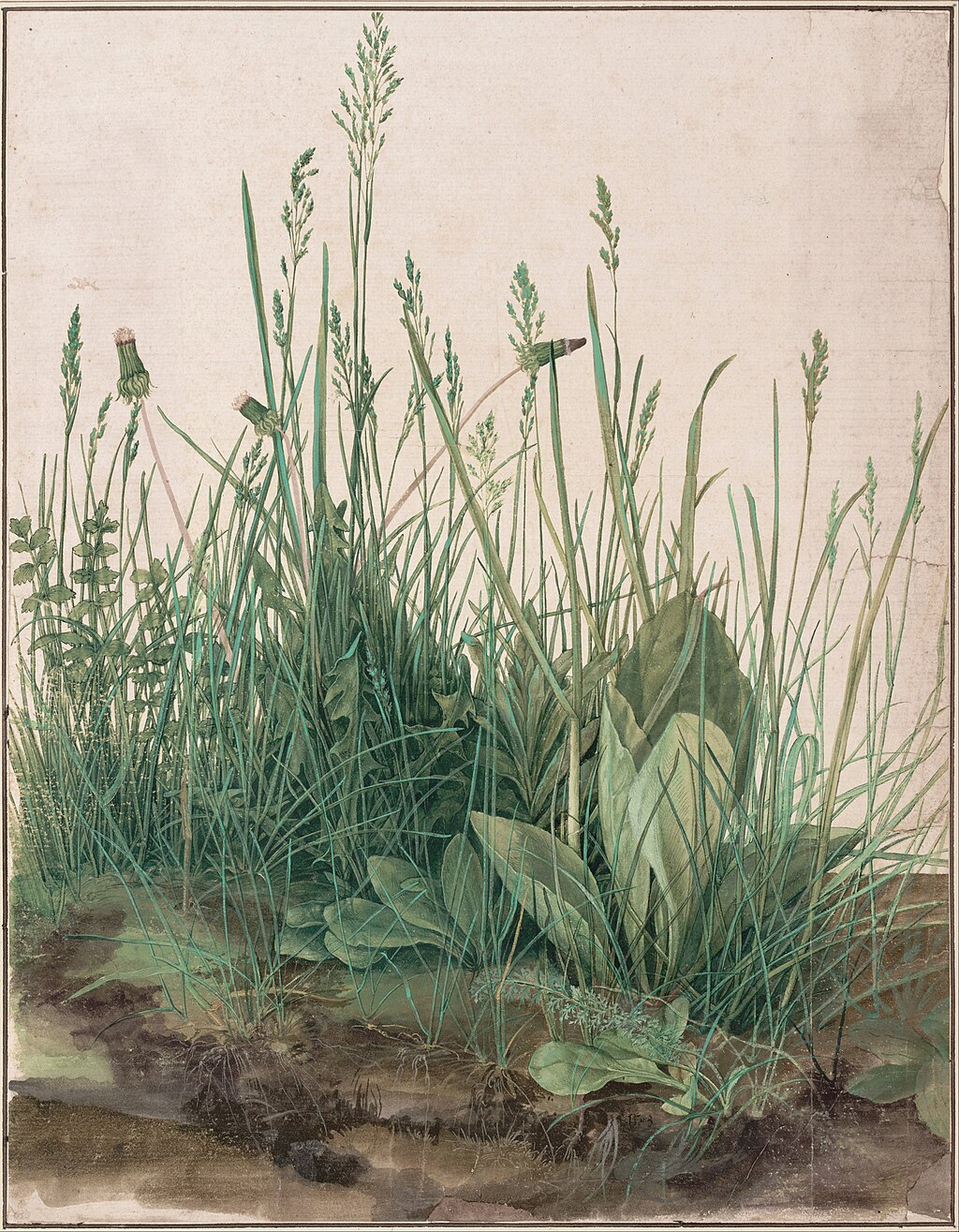
    The Large Piece of Turf, 1503 Albrecht Dürer

    In Spinoza’a world, legibility was the cosmos in an ordered hierarchy. Meaning descended from an external judge and was mirrored by the terrestrial proxy of the King and more often the priest. Behavior was aligned to the “Scriptural Average.” A pre-written behavioral code that transformed the conatus—that primal drive to persist and expand—into the passive states of hope and fear. By removing the external judge, Spinoza suggested that freedom is found in the intellectual mastery of the causes that move us. A pushback against the “average pious subject,” asserting that every individual is a necessary, logical expression of an infinite substance. There is no error in the world, only the lack of a thick enough understanding to perceive the necessity of one’s own outlier status. 

    With this position, and self assurance, Spinoza became illegible to his friends, his doting teacher, and his community. He was cast out, but his thoughts are the seeds of today’s world. 

    In the Beirut and Damascus of the mid-twentieth century, the imposition of legibility took the form of the “Citizen-as-Monument.” It was a world of endings, where identity was a frozen artifact of nationalist scripts and religious orthodoxies. The poet Adonis, through Mihyar, pushes against this world not by asserting a new identity, but through a “movement of erasure.” If a stable interior is to form, it is to be quickly discarded. A stable interior is merely another coordinate, a dependable predictor, for the state to map. Mihyar becomes a “knight of strange words,” defined by the iltifat—the sudden turn away. By peeling back the layers of the social mask and embracing a radical anonymity, he counters the stagnant city. He exists as a hot wind, something that is felt through its movement and friction, yet remains entirely unsearchable by the collective grammar.

    We have entered a third world, a digital landscape that functions as a terraformed plain. It is, in a sense, a Spinozan monism—all data is one substance—but it is a substance managed by a Leibnizian bureaucracy of optimization. The mechanism of control is no longer the scripture or the state monument, but the “Mechanical Harmony” of the statistical mean. A decade ago this was social media shaping votes. Today’s AI tools, perhaps inadvertently and perhaps not,  impose an “averageness” on thought itself, by providing the next likely response and hiding the outlier. This is a form of disindividuation disguised as efficiency, a smoothing of the world’s texture until it becomes a frictionless surface for the sake of searchability.

    What emerges as a necessary response is the logic of the thicket. If the terraformed plain is the habitat of the tourist—where everything is predicted, optimized, and known—the thicket is the habitat of the explorer. It is a deliberate architecture of complexity, an insistence on terroir and the messy, non-replicable context of the local. To build a thicket is to re-introduce friction into a world too smooth. We are apes inhabiting the long tail. Like Spinoza, our conatus withers under the umbrella the statistical mean. If every response is predicted, the individual ceases to be a cause and becomes merely a consequence of the architecture.

    To emerge, life itself needed discontinuities. The thicket provides the opacity necessary for the transforming process of the self to occur. It honors the uneven distribution of the world, providing a high-density environment of unique, complex encounters impossible in a flat plain. In this 2025 context, to be “against the world” is perhaps better understood as being a cultivator of these unsearchable spaces. The Dark Forest of the internet has created literal operating systems, habitats for our interconnected selves. Away from the violent imposition of the center, things can still happen by surprise. We seek cover in the thicket as a primal way of being where the emergent world remains deep enough to inhabit.

    Fediverse Reactions
  • Four Early-Modern Tempers for a World That Can Summon Itself

    This is a partial synthesis of the books read through 2025 in the Contraptions Book Club.

    We live in a moment when the whole of human culture has become strangely available, no longer just an archive but something that behaves like a responding presence. A sentence typed into a search bar or messaging window returns citations and, more strikingly, continuations: pastiche, commentary, new variations of ideas that never existed until the instant we requested them. The canon now behaves more like a voice than a library. It is easy to treat this as convenience, yet summoning culture alters our relation to meaning in ways we are only beginning to see. The question is no longer whether we can find the relevant text, but what it means to think in a world that can generate its own echoes.

    This instability has precedents in the late fifteenth and sixteenth centuries. Print multiplied texts; voyages multiplied worlds; the Reformation multiplied authorities. Four writers—Thomas More, Michel de Montaigne, Giordano Bruno, and Ibn Khaldun—stood at different corners of that era’s turbulence. Read from a certain angle, they reveal four temperaments that recur whenever the world grows larger and more articulate than before. They capture four ways of holding meaning in a world where frames widen and boundaries blur.

    Their temperaments arose under the tension of two kinds of pressures. One pressure concerns frame: how much of the world a thinker attempts to hold in view. Another concerns form: how rigidly one tries to shape or preserve meaning in the face of flux. The tension between narrow and wide frames, between hard and soft forms, is a recurring feature of intellectual upheaval. It is with us again.

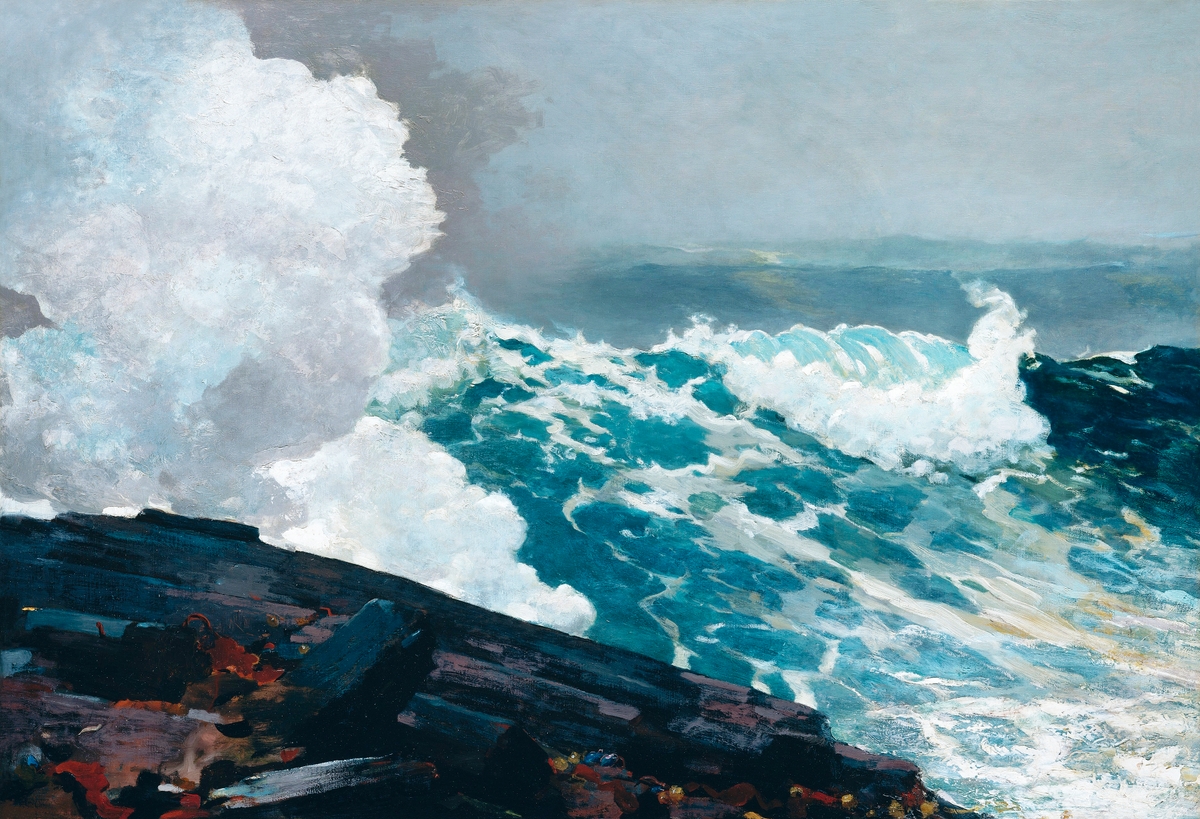
    Northeaster (1895) by Winslow Homer. Original from The MET museum.

    Thomas More and the dream of designed simplicity

    When More wrote Utopia, he was answering a world that felt newly disordered: economic enclosure, fracturing religion, unfamiliar continents, and the early tremors of what we now call modernity. His response was to shrink the frame to a bounded island and then remake that island according to simple, intelligible rules. Clothes are standardized; work is scheduled; houses interchangeable. Property, that generator of complexity, is abolished.

    This gesture—the compression of a vast, unruly world into a legible miniature—reflects a deep conviction that the good life can be engineered by eliminating what does not fit the plan. Yet much of what makes human life livable emerges not from design but from the unplanned: the pleasure of choosing one’s clothes, improvising a routine, rearranging a room, wandering through a market whose wares no one fully controls. These small freedoms, these ambient textures, carry a kind of happiness that explicit blueprints rarely acknowledge. More’s island, for all its order, feels airless because it denies the subtle satisfactions of emergence.

    We still see this impulse today, whenever we imagine that meaning will return if only we can simplify the world enough—reduce choices, curtail variation, enforce legibility. It is a refusal to accept that complexity is a problem to be solved only up to a point, beyond which it becomes the medium of human flourishing.

    Montaigne and the work of making knowledge one’s own

    Montaigne faced the same expansion of texts and reports, but his answer was almost the inverse of More’s. In his Essays, he turned the proliferating world into material for a sustained inquiry into a single life—his own. He narrowed the frame even further—not to an island but to a single life—and then allowed that life’s boundaries to loosen. His essays are records of a mind being changed by what it reads and observes. They are porous documents, absorbing classical quotations, passing impressions, and the texture of his shifting moods.

    He described this process with the image of bees making honey: they gather from thyme and marjoram, but the result is neither; the ingredients have been transformed.  Mere access to texts is not enough. The material must be digested until it becomes inseparable from the person who has absorbed it. 

    This is a temperament well suited to a world in which culture can speak back in any tone we request. The ease of access makes superficial familiarity almost effortless; the difficulty lies in allowing the material to ferment into something one can honestly call one’s own. Montaigne’s form is soft, because he does not impose a system on the world or on himself. He lets contradictions remain. His essays show what inward honesty looks like when the outer world has grown noisy.

    Bruno: infinite worlds, unreliable memory

    If Montaigne compresses the world into a single consciousness, Bruno explodes it. In works such as On the Infinite Universe and Worlds, he offered a speculative cosmology that pushed beyond the scientific imagination of his time. His universe is infinite, populated by innumerable worlds, animated by a universal divinity. These were not scientific inferences—they were imaginative leaps, metaphysical provocations in a period when the cosmological picture was coming loose.

    Bruno’s response to the widened cosmos led him to enlarge the frame until it became boundless. Boundaries, for him, were treated as provisional, always liable to be surpassed. He was fascinated by memory—its limits, its artifices, its potential for augmentation. His elaborate mnemonic wheels were attempts to externalize thinking, to allow a mind to move through more space than it could otherwise hold.

    There is something oddly familiar in this, not because our devices prove Bruno right, but because they echo his aspirations. We have built systems that externalize memory, recombine fragments, and present them as if they had always existed. These contrivances are not cosmic, yet they invite a cosmic mood—a sense that boundaries have thinned, that the archive stirs, that the mind can wander farther than it once could. Bruno illustrates the allure and the danger: the exhilaration of boundless possibility, and the risk of believing that imagination alone can stand in for contact with the world.

    Ibn Khaldun and patterns at civilizational scale

    Ibn Khaldun took the widening of the world seriously, but he kept his feet on the ground. In the Muqaddimah, his great introduction to history, he sketched a theory of how societies cohere, flourish, and decline. His frame is large—empires, dynasties, generations—yet his form is restrained. He offers no blueprint for an ideal state. He offers something closer to a natural history of political life: groups harden and cohere, conquer, soften, decay, and are replaced. Boundaries matter to him—the line between desert and city, between ruler and ruled—but they are not eternal. They shift, erode, reemerge.

    His stance avoids both utopian control and ecstatic dissolution. It is descriptive, analytical, patient. He wants to see how things actually behave across time. In a world that now contains its own searchable memory and can generate plausible continuations of its past, this way of looking feels newly relevant. The swirl of events becomes legible only when placed against deeper patterns. Ibn Khaldun’s gift is to show that large frames can coexist with modesty of form.

    Two diagonals

    One can sense two lines running through these four positions. On one line are More and Bruno—the designer of tight enclosures and the dissolver of all enclosures. Both feel the shock of a world grown too large and respond by refusing its messiness: one by shrinking it to a legible fragment, the other by exploding it into a metaphysical totality. Both try to replace the world’s emergent complexity with a clarity of their own making.

    The other line runs between Montaigne and Ibn Khaldun. Both accept that the world, whether at the scale of a single life or of a civilization, has a texture that cannot be fully captured by design or metaphysics. Both are interested in how things actually unfold, without forcing them into an ideal shape. Their frames differ—one intimate, one panoramic—but their attitude toward form is similar: let patterns emerge, let boundaries be porous enough to reveal movement, let humility guide description.

    This second diagonal sits more naturally with a culture that can be summoned on demand. When the archive can answer back in endless variations, attempts to design simplicity or to dissolve all limits tend to fatigue. What remains workable is the inward practice of belonging to oneself and the outward practice of reading patterns without imagining them eternal.

    Temper temper

    We now inhabit a world in which knowledge behaves differently than any earlier generation anticipated. It can be queried, ventriloquized, recombined. This does not tell us how to live, but it changes the background against which living takes place. More’s dream of a perfectly designed order feels at once more possible and more implausible. Montaigne’s slow digestion of borrowed thought feels newly demanding. Bruno’s intoxication with boundlessness feels familiar, and Ibn Khaldun’s attention to cycles and decay feels newly sober.

    These tempers recur whenever the world becomes more articulate than before. Ours is such a moment. We can now create stable points of reference with enough meaning and legibility to allow exploration of surrounding space. Print unlocked the beta version of this superpower. These four writers, shaped by the last great expansion of the world’s voice, find themselves speaking again through us, as we try to understand what it means to think with culture on tap.

    Fediverse Reactions
  • Better Company Than Caesar

    What is this urge that makes us want to be seen as something we aren’t. Take this blog, for example. I am in no way a writer. Barely even a proper blogger. My professional life has very little of this kind of writing. Scientific and investor communication, sure; but not this. Why do I have — and always have had — this urge to be, and be seen, as creative? Is this some kind of performative, effortless polymathism?

    Orangutan (Orangoetan) (1914) print in high resolution by Samuel Jessurun de Mesquita.

    Perhaps the desire is to be a modern Renaissance man. In of Montaigne’s essays is the following passage:

    “They would rather talk at length about other people’s trade, instead of their own, and so hope to be seen as accomplished in yet another field. Like when Archidamus faulted Periander for abandoning his reputation as a good doctor to acquire one as a bad poet. 

    See how Caesar goes out of his way to make us understand his ingenuity in building bridges and siege weapons. And, conversely, how much he refrains from talking about the responsibilities of his profession, his courage, and how he led his troops. His deeds prove he was an excellent officer. He wants to be known as an excellent engineer, an entirely different occupation!

    Dionysus the Elder was a great military leader, as fortune would have him. But he did everything he could to be known mainly through poetry, although he knew little of it.”

    Montaigne, if not a “Renaissance man”, is a man of the Renaissance. Yet he quotes even older examples of this urge. We have leaders who are CEOs or investors and want to be known or seen as being accomplished engineers or physicists. Fields they are rather bad at. Perhaps there is a common kind of mania here. Maybe it takes hold in the minds of the mover and shakers of history. But what of us not of a geologic character?

    I don’t think this applies to us regular folks. Hobbies and deep interests do provide something critical however. Happiness. I don’t really care much about being seen as an expert in writing, making pretty plots, or even performing some AI-for-biology contortion. I would like to know how to do it and how to do it well. I am led by the pleasures of intense curiosity. That is better company than Caesar, I assure you.

    Maria Popova writes in one of her wonderful essays on Bertrand Russell:

    ‘In my darkest hours, what has saved me again and again is some action of unselfing — some instinctive wakefulness to an aspect of the world other than myself: a helping hand extended to someone else’s struggle, the dazzling galaxy just discovered millions of lightyears away, the cardinal trembling in the tree outside my window. We know this by its mirror-image — to contact happiness of any kind is “to be dissolved into something complete and great,” something beyond the bruising boundaries of the ego.’

    By the end of 2023, I was in proper burnout.*1 It wasn’t until I was able to focus my mind on reading new things that recovery felt possible. Earlier this year I joined the Contraptions book club and that complete focusing of attention has buoyed my mental state even higher. Enough to write regularly and to be ever more creative at my day job.

    So, I guess, the Nobel-winning philosopher and mathematician did know a thing or two when he decided to write a book with the title in The Conquest of Happiness.
    “The secret of happiness is this: let your interests be as wide as possible, and let your reactions to the things and persons that interest you be as far as possible friendly rather than hostile.”


    1. Sidenote: I suspect Montaigne, who was about my age when he started to write also went through a midlife crisis. This sidenote is somewhere between projection and basking in reflected glory. ↩︎
    Fediverse Reactions
  • The Small God of the Internet

    It was a small announcement on an innocuous page about “spring cleaning”. The herald, some guy with the kind of name that promised he was all yours. Four sentences you only find because you were already looking for a shortcuts through life. A paragraph, tidy as a folded handkerchief, explained that a certain popular reader of feeds was retiring in four months’ time. Somewhere in the draughty back alleys of the web, a small god cleared his throat. Once he had roared every morning in a thousand offices. Now, when people clicked for their daily liturgy, the sound he made was… domesticated.

    He is called ArrEsEs by those who enjoy syllables. He wears a round orange halo with three neat ripples in it. Strictly speaking, this is an icon1, but gods are not strict about these things. He presides over the River of Posts, which is less picturesque than it sounds and runs through everyone’s house at once. His priests are librarians and tinkerers and persons who believe in putting things in order so they can be pleasantly disordered later. The temple benches are arranged in feeds. The chief sacrament is “Mark All As Read,” which is the kind of absolution that leaves you lighter and vaguely suspicious you’ve got away with something.

    Guide for Constructing the Letter S from Mira Calligraphiae Monumenta or The Model Book of Calligraphy (1561–1596) by Georg Bocskay and Joris Hoefnagel. Original from The Getty. Digitally enhanced by rawpixel.

    There was a time the great city-temples kept a candle lit for him right on their threshold. The Fox of Fire invited him in and called it Live Bookmarks.2 The moldable church, once a suit, then a car, then a journey, in typical style stamped “RSS” beside the address like a house number. The Explorer adopted the little orange beacon with the enthusiasm of someone who has been told there will be cake. The Singers built him a pew and handed out hymnals. You could walk into almost any shrine and find his votive lamp glowing: “The river comes this way.” Later, accountants, the men behind the man who was yours, discovered that candles are unmonetizable and, one by one, the lamps were tidied into drawers that say “More…”.

    ArrEsEs has lineage. Long before he knocked on doors with a bundle of headlines, there was Old Mother Press, the iron-fingered goddess of moveable type, patron of ink that bites and paper that complains. Her creed was simple: get the word out. She marched letters into columns and columns into broadsides until villages woke up arguing the same argument.3* ArrEsEs is her great-grandchild—quick-footed, soft-spoken—who learned to carry the broadsheet to each door at once and wait politely on the mat. He still bears her family look: text in tidy rows, dates that mind their place, headlines that know how to stand up straight.**

    Four months after the Announcement, the big temple shut its doors with a soft click. The congregation wandered off in small, stubborn knots and started chapels in back rooms with unhelpful names like OGRP4. ArrEsEs took to traveling again, coat collar up, suitcase full of headlines, knocking on back doors at respectable intervals. “No hurry,” he would say, leaving the bundle on the step. “When you’re ready.” The larger gods of the Square ring bells until you come out in your slippers; this one waits with the patience of bread.

    Like all small gods, he thrives on little rites. He smiles when you put his name plainly on your door: a link that says feed without a blush. He approves of bogrolls blogrolls, because they are how villages point at one another and remember they are villages. He warms to OPML, which is a pilgrim’s list people swap like seed packets. He’s indulgent about the details—/rss.xml, /atom.xml, /feed, he will answer to all of them—but he purrs (quietly; dignified creature) for a cleanly formed offering and a sensible update cadence5.

    His miracles are modest and cannot be tallied on a quarterly slide. He brings things in the order they happened. He does silence properly. The river arrives in the morning with twenty-seven items; you read two, save three, and let the rest drift by with the calm certainty that rivers do not take offense. He remembers what you finished. He promises tomorrow will come with its own bundle, and if you happen to be away, he will keep the stack neat and not wedge a “You Might Also Like” leaflet between your socks.

    These days, though, ArrEsEs is lean at the ribs. The big estates threw dams across his tributaries and called them platforms. Good water disappeared behind walls; the rest was coaxed into ornamental channels that loop the palace and reflect only the palace. Where streams once argued cheerfully, they now mutter through sluices and churn a Gloomwheel that turns and turns without making flour—an endless thumb-crank that insists there is more, and worse, if you’ll just keep scrolling. He can drink from it, but it leaves a taste of tin and yesterday’s news.

    A god’s displeasure tells you more than his blessings. His is mild. If you hide the feed, he grows thin around the edges. If you build a house that is only a façade until seven JSters haul in the furniture, he coughs and brings you only the headline and a smell of varnish6. If you replace paragraphs with an endless corridor, he develops the kind of seasickness that keeps old sailors ashore. He does not smite. He sulks, which is worse, because you may not notice until you wonder where everyone went.

    Still, belief has a way of pooling in low places. In the quiet hours, the little chapels hum: home pages with kettles on, personal sites that remember how to wave, gardeners who publish their lists of other gardeners. Somewhere, a reader you’ve never met presses a small, homely button that says subscribe. The god straightens, just a touch. He is gentler than his grandmother who rattled windows with every edition, but the family gift endures. If you invite him, tomorrow he will be there, on your step, with a bundle of fresh pages and a polite cough. You can let him in, or make tea first. He’ll wait. He always has.


    Heavily edited sloptraption.


    1. He maintains it’s saffron, which is what halos say when they are trying to be practical ↩︎
    2. The sort of feature named by a librarian, which is to say, both accurate and doomed. ↩︎
    3. Not to be confused with the software that borrowed her title and a fair chunk of her patience. ↩︎
    4. Old Google Reader People ↩︎
    5. On festival days he will accept serif, sans-serif, or whatever the village printer has not yet thrown at a cat.
      ↩︎
    6. He can drink JSON when pressed; stew remains his preference. ↩︎
    Fediverse Reactions
  • What do platforms really do? 

    In 1986, David S. Landes wrote the essay, ‘What Do Bosses Really Do?’. He argues that the historical role of the ‘boss’ was an essential function for organizing production and connecting producers to markets. Digital platforms have become the new bosses. Platforms have the same functions of market creation, labor specialization, and management, but they have replaced the physical factory floor with algorithmic management. While their methods are novel, platforms are the direct descendants of the merchant-entrepreneurs and factory owners Landes described, solving the same historical problems of production in remarkably similar ways.

    Design for a Teacup (1880-1910) painting in high resolution by Noritake Factory. Original from The Smithsonian Institution. Digitally enhanced by rawpixel.

    So, why am I posting this on my own blog and not on a “platform”? I don’t view writing as a financial transaction. It is a hobby. By putting the financialization lens front and center, platforms are killing the mental space for hobbies. When you monetize tweets, you create incentive to craft tweets that create engagement in particular ways. Usually not healthy ways. 

    If we think of old media or traditional manufacturing, we can compare them to guilds. Guilds kept up prices and controlled production. With the simplification of tasks factories could hire workers who weren’t as highly skilled but didn’t need to be. Nowadays, why should any newspaper or TV channel’s output be limited by the amount of airtime or page space they have?

    Platforms take unskilled and train them. We are in the age of specialization of ideas.  Akin to the “the advantage of disaggregating a productive process”  Platforms leverage this by having many producers explore the same space through millions of different angles. This allows the platform to “purchase exactly that precise quantity of [skill] which is necessary for each process” —paying a viral star a lot and a niche creator a little, perfectly matching reward to market impact. Which is to say platforms make money through whatever sticks.  

    In Landes’s essay, Management became specialized, today management will become algorithmized. Platforms abstract away the issues that factory owners had such as embezzlement of resources, slacking off etc. Platforms don’t care how much or how little you produce, or even if you produce. If you do, the cash is yours (after a cut of course). 

    This may lead to a visceral reaction against platforms. This week when Substack raised a substantial amount they called the writers “the heroes of culture”. This should ring at least a tiny alarm in your head. The platform’s rhetoric of the creator-as-hero is a shrewd economic arrangement. In the putting-out system, the merchant-manufacturer “was able to shift capital expenditures (plant and equipment) to the worker”. Platforms do the same with creative risk. The writer, artist, or creator invests all the time and labor—the “capital” of creation—upfront. If they fail, they bear the entire loss. The platform, like the putter-outer, only participates in the upside, taking its cut from the successful ‘heroes’ while remaining insulated from the failures of the many.

    So what do platforms really do? They have resurrected the essential role of the boss for the digital age. They are the merchant-manufacturers who build the roads to market, and they are the factory owners who discipline production—not with overseers, but with incentive algorithms. By casting the creator as the hero, they obscure their own power and shift the immense risks of creative work onto the individual. While appearing to be mere background IT admins, they are, in fact, the central organizers of production, demonstrating that even in the 21st century, the fundamental challenges of coordinating labor and capital persist, and solving them remains, as it was in the 18th century, a very lucrative role.


    What Do Bosses Really Do?, David S. Landes, The Journal of Economic History, Vol. 46, No. 3 (Sep., 1986), pp. 585-623 (39 pages). https://www.jstor.org/stable/2121476

    Fediverse Reactions
  • Royalty, Administration, and Antimemetics

    I was all of 15 when defenestration was forever implanted in my mind. It means to throw someone out the window. It happened in Prague, 1618. Some important people were defenestrated, fell 70 feet, landed in dung. This led to the thirty years war and the coining of the word ‘defenestration’. Defenestrating happened to important, visible, people held responsible for mismanagement leading to widespread discontent. While the defenestrated may represent the idea, surely we can’t imagine that it was that specific person who was going around causing the suffering. No, they had minions. Here we explore a bit of their story. 

    Horned owl (Hoornuil) (1915) print in high resolution by Samuel Jessurun de Mesquita. Original from The Rijksmuseum. Digitally enhanced by rawpixel.

    Royalty is meant to be seen. They were either chosen by or were the local gods to lead the people. They were the head of everything and if something were to go wrong it was their responsibility. Royalty also means creating good memes. Whether the Alhambra, Taj Mahal, or Beijing projecting power through architectural memes was the standard.

    Administration and bureaucratic structures is the silent clockwork that powers the projection. These guys, are antimemetic. The antimeme is a recent invention and denotes ideas that have high impact but are hard to spread. This is important because when the tax burden gets too high you want the peasants to go for the king not the local tax collector. 

    The Mughal emperors were the head of the administrative machinery with final say over all important matters. The administration itself was antimemetic in nature. The provincial officials such as the bakhshi, sadr as-sudr, and finance minister reported directly to the central government rather than the subahdar (provincial governor). Matrix organization, I hear you thinking. This complex, multi-layered reporting structure, while designed for central control, also diffused responsibility and made the precise locus of decision-making less transparent to external observers and even to other officials.

    In the Ming dynasty, the Hongwu Emperor abolished the Central Secretariat to assume personal control. However, the volume of letters got so high that he soon appointed a few grand secretaries. They never held a high rank and always merely “recorded imperial decisions”. If merely were a boxer he would be a heavyweight. Can’t blame that guy with the pen if he’s just doing what the king asks him to.

    From the al-Andalus through the Ottomans, Safavids, and Mughals the the ulama shaped legal systems and molded public morality. Of course the monarchs decrees but the ulama interpreted them and applied them as law into daily life. This interpretive authority, operating subtly within the legal and religious bureaucracy, allowed for continuous adaptation and influence without the visible, attributable acts of formal legislation, making it profoundly antimemetic. 

    Let me end with the quote from the wonderful, and joyfully mimetic, Yes, Minister:

    Hacker: Humphrey, did you know that 20% of all honours go to civil servants?

    Sir Humphrey: A fitting tribute to their devotion to duty, Minister.

    Hacker: No, their duty is what they get paid for. The rest of the population has to do something extra to get an honour. Something special. They work for 27 years with mentally handicapped children six nights a week to get an MBE. Your knighthoods simply come up with the rations.

    Sir Humphrey: Minister, her Majesty’s civil servants spend their lives working for a modest wage and at the end, they retire into obscurity. Honours are a small reward for a lifetime of loyal, self-effacing discretion and devoted service to Her Majesty, and to the nation.

    Hacker: “A modest wage”, did you say?

    Sir Humphrey: Alas, yes.

    Hacker: Humphrey, you get over £30,000 a year! That’s £7,000 more than I get.

    Sir Humphrey: Yes, but still relatively the modest wage.

    Hacker: Relative to whom?

    Sir Humphrey: Well, Elizabeth Taylor, for example.

    Hacker: Humphrey, you are not relative to Elizabeth Taylor. There are important differences.

    Sir Humphrey: Indeed, yes. She didn’t get a first at Oxford.

    Hacker: And you do not retire into obscurity?! You take a massive index-linked pension and go off to become directors of oil companies and banks.

    Sir Humphrey: Oh, yes, but very obscure directors, Minister.

    Hacker: You’re in no danger of the sack. In industry if you screw things up, you get the boot. In the civil service, if you screw things up, I get the boot.

    Sir Humphrey: Very droll, Minister, now if you’ve approved the list…”

    [Series Two (1981) Episode Two: Doing the Honours]


    Sources

    Much of the reading and sourcing of material for this was done across books from the Contraptions Book Club and some deep research help.

    Fediverse Reactions
  • Financial Instruments and the Ottoman Empire’s Decline (16th–19th Centuries): A Comparative Analysis


    This essay was explored with ChatGPT o3 as a curiosity while reading Islamic Gunpowder Empires by Douglas E. Streusand as part of the Contraptions Book Club


    Introduction

    The decline of the Ottoman Empire from the reign of Süleyman the Magnificent (1520–1566) through the 1800s was closely intertwined with its financial system. A combination of internal fiscal instruments – such as the timar land-tenure system, tax farming (iltizam), coinage debasements, and halting reform efforts – and external financial dependencies – including capitulatory trade agreements, foreign loans, and reliance on European capital – weakened the empire’s economic foundations. This report examines how these financial tools contributed to Ottoman decline, and compares the Ottoman fiscal system with contemporaneous innovations in Venice, the Dutch Republic, England, and the Habsburg Empire. By analyzing public debt management, state banking institutions, military finance, and credit markets, we highlight how European states developed resilient “fiscal-military” systems that gave them economic and military leverage over the ailing Ottoman state. The analysis is supported by historical and academic sources, and a comparative table summarizes key differences.

    Art Nouveau Flower pattern stencil print in oriental style. 1914 edition of Samarkande: 20 Compositions en couleurs dans le Style oriental” (Samarkand: 20 Color Compositions in the Oriental Style) by E. A. Séguy

    Ottoman Internal Financial Instruments and Fiscal Challenges (16th–18th Centuries)

    The Timar System and the Rise of Tax Farming

    Under Süleyman I, the Ottoman Empire’s finances appeared robust. A pillar of the classical system was the timar: land grants to cavalry officers (sipahis) who collected taxes in return for military service. This decentralized feudal revenue system initially provided a steady supply of troops at low direct cost to the central treasury. However, by the late 16th century, signs of strain emerged. As the empire’s territorial expansion stalled and inflation eroded fixed revenues, the timar system began to break down. Many timar lands were seized by powerful elites and effectively converted into private estates, depriving the state of both manpower and revenue that these lands once provided.

    To raise immediate cash, the government increasingly turned to tax farming (iltizam). Instead of collecting taxes directly, the treasury auctioned the right to collect provincial taxes to the highest bidder, who paid the state an upfront sum and then extracted revenues from the populace. While this provided short-term infusions of money, it incentivized farmers to maximize extraction over short tenures rather than sustainably manage resources. Observers noted that holders of timars and tax farms began to “exploit [revenues] as rapidly as possible, rather than as long-term holdings”, often abusing taxpayers and neglecting future productivity. In the late 17th century, the Ottoman state attempted a reform by instituting life-term tax farms (malikâne) to encourage longer-term investment in tax sources. Yet, corruption frequently allowed influential holders to secure hereditary control or turn tax farms into tax-exempt waqf endowments, “without any further obligations to the state”. This erosion of central authority over revenue reduced the funds available for the army and administration, contributing to imperial weakness.

    Monetary Debasement, Inflation and Fiscal Crisis

    When taxation and timar revenues proved insufficient, the Ottomans resorted to another expedient: monetary debasement. Successive sultans debased the silver coinage (akçe and later kuruş) by reducing its precious metal content, effectively raising nominal revenue at the cost of inflation. This policy had precedent – as early as the 15th century, Sultan Mehmed II used periodic debasements to fund his campaigns – but it became especially damaging in the late 16th and 17th centuries. The influx of New World silver into Europe drove up prices (the “Price Revolution”), and the Ottoman akçe’s value plummeted in international trade. In response, the treasury sharply debased the coinage in the late 1500s, triggering rapid inflation that disrupted the economy. Contemporary accounts describe how by the 1580s–1590s, prices for basic goods soared while soldiers’ and officials’ salaries (paid in debased coin) lost purchasing power. Indeed, “the treasury…began to meet its obligations by debasing the coinage,” but “all those depending on salaries found themselves underpaid,” leading to further corruption and unrest. Unpaid or underpaid Janissaries reacted with riots and mutinies, and provincial revolts (such as the Celali rebellions) had economic hardship as a backdrop.

    Throughout the 17th and 18th centuries, fiscally motivated debasements were frequent, especially in wartime. Each debasement provided a short-lived budgetary fix but undermined long-term confidence in the currency. Notably, during the centralizing reforms of Sultan Mahmud II (r. 1808–1839), the empire carried out the “largest debasement ever in Ottoman history” – the silver content of the kuruş was reduced by over 80% between 1808 and 1844. The exchange rate of the kuruş to the British pound sterling collapsed from 18:1 to roughly 110:1 in that period. This caused steep inflation and hit fixed-income groups (bureaucrats, ulema, and especially the Janissary corps) the hardest. By the 19th century, it became clear that constant debasement was unsustainable – in 1844 the Ottoman government finally overhauled the coinage, adopting a bimetallic standard and stable gold-backed Ottoman lira, to restore credibility. Yet by then, decades of inflation had eroded popular trust and fiscal stability.

    Public Finances and Attempts at Reform

    Ottoman public finance in this era struggled to adapt to new realities. The empire’s traditional revenue system had been sufficient during the 16th-century expansion, but proved inadequate against rising military costs and economic change. Crucially, the Ottoman state did not develop a funded public debt system in the early modern period akin to those in Europe. Islamic law’s discouragement of interest limited formal public borrowing, and instead the treasury relied on informal loans from Galata bankers and advance payments from tax farmers. Only in the late 18th century did the Ottomans introduce a domestic debt instrument: the esham (shares in lifelong tax annuities). First issued in 1775 after a costly war with Russia, the esham allowed investors to pre-pay a sum to the treasury in exchange for a lifelong annual income from specific tax revenues. In essence, this was an Ottoman form of life annuity or bond. While the esham system marked a step towards modern public borrowing, it remained limited in scale and was structured to avoid explicit interest, thus offering less flexibility than European bonds.

    Fiscal reform efforts gained urgency in the early 19th century. Selim III (r. 1789–1807) and Mahmud II attempted to recentralize tax collection and curb abuses by powerful provincial ayans (notables). After destroying the Janissary corps in 1826, Mahmud II pursued financial centralization, including abolishing most tax farms and trying to collect taxes through salaried officials. These reforms, alongside the 1840s Tanzimat reforms (which promulgated a more equitable tax system and budgets), did modestly improve state revenues. In fact, the central government’s tax revenue as a share of GDP, which had languished around an estimated 3% in the early 19th century, rose to over 10% after mid-19th century centralizing reforms. Despite this improvement, it was a belated catch-up. As one study notes, “most European states had experienced significant increases in revenues during the early modern era… while Ottoman revenues were in fact declining” in the eighteenth century. Thus, even the 19th-century Ottoman revenue gains were “the results of delayed political and fiscal centralization”. By the time the Ottomans built a modern finance system, it was under great external pressure and hampered by the empire’s accumulated weaknesses.

    External Financial Dependencies and their Impact

    Capitulations: Trade Privileges and Lost Revenues

    From the 16th century onward, the Ottomans granted Capitulations – treaties giving European merchants and diplomats special privileges in Ottoman territories. Süleyman I’s agreements with France (1536) and later capitulations to other powers allowed foreign merchants low fixed customs duties (often around 3%) and extraterritorial legal rights. In the short term, these deals aimed to encourage trade and secure alliances. However, over the long term, capitulations created an unequal trading regime that undercut Ottoman finances. European merchants (and local non-Muslim intermediaries under European protection) flooded the Ottoman market with cheap imported manufactures, but Ottoman authorities were largely unable to increase tariffs beyond the low rates locked in by capitulatory treaties. By the 18th century, this meant that Ottoman craft guilds and industries, operating under strict price controls, could not compete with European goods entering “without restriction because of the Capitulations”, leading to “traditional Ottoman industry [falling] into rapid decline.”. The empire not only suffered deindustrialization but also missed out on potential tariff revenues that European states were capitalizing on. Capitulations thus constrained the Ottoman fiscal base, making the state increasingly dependent on domestic agrarian taxes (already strained by tax farming inefficiencies) while trade revenues stagnated.

    Furthermore, capitulatory privileges exempted foreigners (and their local protégés) from many local taxes and even from the jurisdiction of Ottoman courts. This fostered a quasi-colonial economic environment in ports like İzmir and Alexandria. Foreign consuls often extended protection to Ottoman Christians and Jews, who in turn dominated lucrative export-import businesses at the expense of Muslim merchants. The overall effect was a drain on Ottoman financial sovereignty: the empire’s role in global commerce shifted from that of a controller (as it had been on the Silk Road before 1600) to largely a supplier of raw materials and consumer of European goods, with little ability to regulate commerce for its own treasury’s benefit.

    Reliance on Foreign Loans and European Capital

    In the mid-19th century, the Ottoman Empire’s fiscal troubles pushed it into external borrowing – a new and perilous dependency. The first major foreign loan was taken in 1854, during the Crimean War, to finance military expenses. Over the next two decades, Istanbul floated dozens of loans from European creditors (primarily British and French banks), often on onerous terms. By 1875 the nominal public debt had swollen to £200 million, an immense sum for the Ottoman budget. Annual interest and amortization payments reached £12 million – consuming “more than half of the national revenue.” In other words, over 50% of Ottoman state income was absorbed just by servicing debt, a clearly unsustainable burden. In that same year (1875), facing a global financial downturn and domestic fiscal shortfalls, the Ottoman government defaulted on its debt payments, admitting it could only cover half the interest due. This financial collapse precipitated an international intervention in Ottoman finances.

    Creditors from the major European powers forced the empire to accept the Ottoman Public Debt Administration (OPDA) in 1881. This institution, run largely by European appointees, took control of key Ottoman revenue streams (such as the salt tax, tobacco tax, and customs duties) to ensure debt repayment at the source. Effectively, the OPDA meant partial control of state finances by European creditors until World War I. While this arrangement restored the Ottoman government’s creditworthiness (allowing it to borrow again at lower interest rates in subsequent years), it deeply compromised Ottoman sovereignty. European financial oversight dictated budget priorities, with creditor interests often trumping the empire’s domestic needs.

    Beyond sovereign debt, European capital penetrated the Ottoman economy via direct investments: railways, ports, mining concessions, and the establishment of the Ottoman Bank (1856) which was British-French controlled and served as a quasi-central bank. The Ottomans were thus integrated into European capital markets but on unequal terms – mostly as debtors and as a zone of investment for outside interests. By the late 19th century, the empire was locked in a cycle of dependency: needing foreign loans to fund reforms or military expenditure, but those very loans leading to foreign supervision and further loss of revenue autonomy. This external financial reliance was both a symptom of the Ottoman decline and a cause of its acceleration, as the empire’s inability to independently mobilize resources left it vulnerable to diplomatic and economic pressure from the Great Powers.

    European Fiscal Innovations vs. the Ottoman System

    Early modern Europe witnessed a “financial revolution” in statecraft that the Ottoman Empire largely missed until it was too late. European states developed new financial instruments and institutions – from permanent public debts to central banks and sophisticated credit markets – which underpinned their rise in power. Below, we compare the Ottoman financial system to those of Venice, the Dutch Republic, England, and the Habsburg monarchy, emphasizing public debt management, banking, military finance, and credit markets. The contrast reveals how European innovations yielded greater fiscal resilience and military-economic leverage.

    Public Debt and Credit Markets: Ottoman Lag vs. European Innovation

    One of the starkest differences was in public debt management. Unlike the Ottomans, who avoided long-term interest-bearing debt until the late 18th century, several European states had developed perpetual public debts centuries earlier:

    • Venice: Pioneered public borrowing as early as the 12th–13th centuries. The Venetian Republic’s government issued prestiti (forced loans from wealthy citizens) which evolved into transferable government bonds. By 1261 Venice had reorganized its debt into the Monte Vecchio, and set a standard interest rate of 5% on these perpetual bonds. For roughly a century the rate held steady, indicating investor confidence. A secondary market for Venetian bonds flourished by the late 1200s – nobles traded them and used them as dowry assets, with prices publicly quoted. The state even established a sinking fund to buy back bonds when prices fell, shoring up the market. These practices made Venice’s credit extremely robust for the era; historians have dubbed the prestiti the first “AAA” government bonds for their reliability. Venice thus could finance costly wars (against Genoa, the Ottomans, etc.) by floating debt rather than resorting to debasement or ruinous taxation. This early financial sophistication eluded the Ottoman Empire, which lacked a comparable credit instrument during its 16th-century heyday and long after.
    • Dutch Republic: During its war of independence (1568–1648) against Habsburg Spain, the Netherlands (especially the province of Holland) developed a modern system of public finance. The Dutch raised enormous sums via voluntary bonds, backed by new permanent taxes. By the mid-17th century the Dutch Republic was able to borrow at remarkably low interest rates – around 5%, dropping to 4% by the 1660s. Dutch public bonds (including annuities called losrenten and lijfrenten) were widely held by a large investor base, and the interest rates were “equal to, or lower than, the lowest interest returns available in the private sector.” In fact, the Dutch essentially introduced the concept of perpetual, interest-only national debt: the government often paid only interest and could postpone principal redemption indefinitely, allowing it to “spend according to its needs without practical limit”. This extraordinary credit capacity enabled the tiny Dutch Republic to field armies and navies in excess of what its tax revenue alone could support. By the late 17th century, Amsterdam had become the financial capital of Europe – Dutch financiers not only funded their own state but also started investing heavily in other nations’ debts. In comparison, the Ottoman Empire’s nascent attempts at internal borrowing (like the esham of 1775) were timid and expensive, and the empire had to pay much higher effective interest when it finally issued Eurobonds in the 1850s (often borrowing at 8–12% when underwriting costs are included). The absence of a deep domestic credit market left the Ottomans fiscally brittle.
    • England (Britain): England was a latecomer compared to Italy or the Netherlands, but by the 18th century it surpassed them through what historians call the Financial Revolution. After 1688, the English state, now constrained by Parliament, established the Bank of England (1694) and began issuing a funded National Debt. The Bank of England’s creation was pivotal: previously English monarchs had to borrow from private lenders at up to 30% interest, but with the Bank’s formation (and its initial £1.2 million loan to the government at 8%), the state’s credit vastly improved. The Bank intermediated between investors and the state, creating a liquid market for government bonds. By the mid-18th century, Britain was selling long-term bonds at 3%–5% interest, comparable to the Dutch rates, and far below the cost of capital for the Ottomans. Each major war saw Britain’s national debt mount: from about 22% of GDP in 1700 to an staggering ~155% of GDP on the eve of the Napoleonic Wars. Yet Britain never defaulted; instead it serviced the debt via regular taxation and enjoyed access to “large pools of financing [as] a strategic advantage over its rivals.” In effect, Britain could wage war on credit, deferring the costs over decades, whereas the Ottoman Empire – lacking such credit mechanisms – often had to either curtail military operations or resort to desperate measures like debasing currency when funds ran out. The concept of marketable, liquid government debt, which Britain and the Dutch mastered, was largely absent in the Ottoman fiscal arsenal until the very end, when it came under foreign tutelage.
    • Habsburg Empire (Austria): The Habsburg monarchy (Austria and its Central European territories) offers a intermediate case. In the 16th–17th centuries, the Habsburgs’ finances were quite strained; they relied on a patchwork of estate contributions, high-interest loans from Italian and German bankers, and often fell into arrears or partial defaults (the Spanish Habsburgs famously went bankrupt several times in the 16th century). However, the constant Ottoman threat and wars in Europe forced Habsburg Austria to attempt fiscal reforms. By the 18th century, Maria Theresa and Joseph II introduced more centralized taxes and began to institutionalize public credit. For example, after the Seven Years’ War (1756–1763) inflicted massive costs, the Austrian treasury had to service a huge war debt that “for the remainder of Maria Theresa’s reign” dominated policy. This led to the creation of the Vienna Stadtbank and other instruments to consolidate and manage debt. The Habsburgs never achieved the low interest rates of Britain or Holland – their credit was seen as riskier – but by the early 19th century Austria had a central bank (established 1816) and an increasing tax base. Still, compared to Britain’s ~8% of GDP tax intake in the eighteenth century, Habsburg taxes were lower and its debt less sustainable, contributing to Austria’s financial crisis and default in 1811 during the Napoleonic Wars. In sum, the Habsburgs did move toward the European model of funded debt and fiscal centralization, but more slowly and with frequent setbacks. Tellingly, even this partial modernization was more than what the Ottomans managed until very late – by which time the Habsburgs (and other European states) could draw on British subsidies or international loans in their wars against the Ottomans.

    State Banking and Monetary Institutions

    European advances in banking and monetary policy also contrasted with Ottoman practices:

    • Venice and Italy: Venice established one of the first public banks, the Banco di Rialto in 1587, followed by the Banco del Giro. These were primarily banks of deposit and transfer, created to stabilize the currency and facilitate trade payments. While not “central banks” lending to the state, they enhanced Venice’s financial infrastructure by providing a stable credit system for merchants. Italian city-states like Genoa and Florence had earlier innovations (e.g. Genoa’s Bank of St. George managed state debt). The Ottomans, by contrast, had no equivalent public banking institution in the classical period. Money changing and credit were left to private sarraf (moneylenders), often from minority communities, operating without a unified regulatory framework. This meant higher transaction costs and interest rates for the Ottoman government when it needed short-term credit.
    • Dutch Republic: The Amsterdam Wisselbank (Exchange Bank) founded in 1609 was a crucial institution. It was a city-owned bank that accepted deposits of coin and allowed cashless transfers, greatly simplifying trade finance. It helped keep the Dutch currency stable and became a hub for European bullion trading. Though the Wisselbank did not directly finance government debt, its sound operations underpinned Amsterdam’s role as a financial center and increased confidence in Dutch financial instruments. The Ottomans, lacking such a bank, faced chronic currency instability (periodic debasements, as discussed) and could not as effectively mobilize the wealth of their merchants for state purposes.
    • England: The Bank of England (est. 1694) was revolutionary because it combined central banking functions with public debt management. In return for lending to the state, the Bank was granted note-issuing powers, effectively creating a paper money backed by government debt. Over the 18th century, the Bank became the lender of last resort and war financier for Britain. It coordinated with the Treasury to manage the national debt and stabilize the financial system (for instance, during crises it intervenated to shore up confidence). The Ottoman Empire did not establish a comparable institution until the mid-19th century, and even then the Ottoman Bank (originally founded 1856, reconstituted as the Imperial Ottoman Bank in 1863) was operated by British and French interests. The Ottoman Bank issued banknotes and acted as treasury banker, but its policy was often aligned with protecting European creditors’ interests, not purely the Ottoman economy. Without an independent central bank, the Ottoman state lacked tools to conduct monetary policy or to readily raise short-term funds in emergencies – tools that Britain used to great effect.
    • Monetary Stability: By the 19th century, most Western European states adopted gold or bimetallic standards, ensuring stable currencies which helped attract investment and keep borrowing costs low. Britain, for example, was effectively on a gold standard by the early 19th century and enjoyed low inflation. The Ottomans only stabilized their currency with the 1844 reform (switching from the debased kuruş to a new gold lira). Before that, continuous debasements had caused such price chaos that, as noted, economic actors in the empire were well aware of “who gained and who lost” from each coinage change. The relative stability of European currencies (especially the Dutch gulden and British pound) versus the chronic Ottoman currency crises further enhanced investor trust in European financial instruments and distrust in Ottoman ones. This divergence was self-reinforcing: stable money allowed Europeans to sustain large standing armies and navies (paid in reliable currency), whereas the Ottoman armed forces were frequently restive over debased pay.

    Taxation, Military Finance, and Expenditure

    Underpinning debt and banking was the ability to extract revenue. European states gradually built more effective tax systems than the Ottoman Empire:

    • By the 18th century, Britain and France had developed professional fiscal bureaucracies that directly collected customs, excises, and land taxes, largely eliminating tax farming. Britain’s tax revenue reached about 8–12% of GDP in the late 18th century, among the highest in Europe, funding both debt interest and a worldwide war effort. The Ottoman central government, even after reforms, collected around 3–5% of GDP in taxes until much later. This lower tax base meant fewer resources for the military. The Ottomans still relied heavily on provincial elites to raise troops and funds, whereas European monarchies could tap national wealth through centralized taxes.
    • Habsburg Austria lagged Britain/France but still increased its fiscal intake over time through centralized customs (the 1775 Austrian customs union) and new land taxes, despite resistance from nobles. In the critical wars of the late 17th century (Great Turkish War) and early 18th century, Austria’s ability to levy extraordinary war taxes (and receive foreign subsidies) helped it field armies that eventually outmatched the Ottomans. For example, by mobilizing the resources of the relatively prosperous Bohemian and Austrian lands, the Habsburgs could maintain a steady military pressure that the Ottomans, facing a bankrupt treasury and restive provinces, struggled to counter.
    • The Dutch Republic famously imposed very heavy taxes (especially excise taxes on consumption) to pay for its defense. In Holland, taxpayers bore burdens that astonished contemporaries but were accepted as the price of freedom from Spain. The Dutch could spend a high proportion of national income on their military (in the 17th century) without courting immediate fiscal collapse, thanks to a combination of high taxes and cheap debt. The Ottomans, in contrast, often had to reduce military campaigns due to lack of funds or resort to emergency measures (like seizing the properties of deceased officials or levying arbitrary surcharges) which had deleterious political effects.

    In terms of military finance, the European states’ financial superiority translated directly into greater resilience and reach:

    • War Financing: Britain in the 18th century is a prime example – it fought numerous expensive wars (War of Spanish Succession, Seven Years’ War, Napoleonic Wars) by issuing debt and increasing taxes primarily to service that debt, not to pay war costs upfront. By one estimate, “until 1799 Britain’s eighteenth-century wars were financed by incurring debt; taxes were increased simply to pay the interest”. This model allowed Britain to mobilize resources far exceeding its annual revenue, something the Ottomans could not do. When the Ottoman Empire engaged in protracted conflicts (such as the 1768–1774 war with Russia or the 1877–78 war), it quickly exhausted available funds, leading to delayed soldier salaries, mutinies, and desperation measures (like the 1875 foreign debt moratorium). European powers could fight longer and rebound faster. For instance, after the costly Crimean War (1853–56), Britain and France absorbed the debt and moved on, whereas the Ottomans were left financially prostrate, having borrowed heavily during the war and then struggling to pay thereafter.
    • Resilience to Shocks: European states also proved more resilient to economic shocks from war. As Karaman and Pamuk observe, the centralized European fiscal-military states “captured increasing shares of resources as taxes” and “enjoyed greater capacity to deal with domestic and external challenges,” even being “able to shield their economies better against wars.”. In practice, this meant that even when wars caused debt spikes or temporary economic dislocation in Europe, the state’s credit and administrative structures kept the economy functioning. In the Ottoman case, wars often led to economic breakdown – for example, the 1877–78 Russo-Turkish war pushed the already indebted empire into severe default and an eventual foreign-controlled financial regime.
    • Military-Technical Edge: The superior financing of European powers enabled sustained investment in military technology and infrastructure – shipyards, firearms production, and later railways and telegraphs – which the Ottomans, with their strained budgets, struggled to match. The British Royal Navy, the Dutch fleet, or Austrian artillery could be expanded and modernized continuously through funded expenditures, whereas the Ottomans often fell behind in weaponry when they could not afford updates. By the 19th century, the Ottomans tried to modernize their army and navy, but had to rely on foreign credit and expertise to do so, further entangling them with European financiers.

    Comparative Fiscal-Military Indicators (Ottoman Empire vs. Selected European States)

    To summarize the key differences, the table below contrasts the Ottoman financial system with those of Venice, the Dutch Republic, England (Great Britain), and the Habsburg Austrian Empire in the early modern period. It highlights how innovations in public debt, banking, and taxation gave European states a marked advantage:

    Aspect (16th–18th c.)Ottoman Empire (1520s–1800s)Venice (Italian states)Dutch Republic (17th c.)England/Britain (18th c.)Habsburg Empire (Austria)
    Taxation & RevenueRelied on timar feudal levies and tax farming; central revenue ~3% of GDP until 19th c. reforms. Tax collection often privatized (iltizam), leading to inefficiencies and corruption.Mix of direct taxes and trade duties; efficient bureaucracy for a city-state. Could impose extraordinary taxes during wars (e.g. assessed on wealth). Per capita tax burden high during conflicts, but Venice’s rich trade helped revenue.Heavy excise and property taxes by provinces (Holland) to fund war. Very high tax burden accepted; Holland’s taxes perhaps 10%+ of provincial income. Decentralized but effective – taxes were permanent and serviced debt.Centralized tax system after 1688; tax revenue ~8–12% of GDP in 18th c, collected via professional customs and excise offices (e.g. on tea, sugar, land tax). High per-capita taxes (especially compared to Ottomans), fueling military spending.Patchwork of regional taxes; had to negotiate with nobility (especially in Hungary). 18th c. reforms introduced new land and customs taxes. Tax revenue grew but remained lower than Britain/France. Much revenue consumed servicing past debts.
    Public DebtNo permanent national debt until late 18th c. Introduced esham annuities in 1770s (life-income shares), but scale was small. Relied on ad hoc local loans and, post-1854, foreign loans (which reached £200 million by 1875). Defaulted in 1875; European-controlled OPDA managed revenues after 1881.Perpetual bonds (prestiti) from 13th c. at 5% interest. Debt widely held, actively traded; Venice maintained investor confidence with buy-backs and reliable interest payments. Enabled long-term war financing without debasing currency.Funded national debt from late 16th c. Provinces (esp. Holland) issued bonds at 6–8%, later <5%. By 17th c., Dutch debt was immense but sustainable – interest-only loans, no set maturity. Dutch credit reputation so strong that they financed other nations too.Permanent national debt after 1694. Sold bonds (consols) at 3–6%; interest paid from dedicated taxes. National debt rose dramatically (155% of GDP by 1800s) but was serviced reliably. Bank of England helped manage debt issuance. No default; high credit allowed Britain to fund global wars on unprecedented scale.Borrowed through loans from bankers and public bonds mostly in late 18th c. Austria had no central debt market early on – used Anticipations (short-term notes) and some annuities. War of Austrian Succession and Seven Years’ War led to large debts; by 1760s debt servicing was a major budget item. Did not achieve as low interest rates as Britain/Dutch (Austrian bonds often ~6–7%+). Defaulted in 1811 amid Napoleonic pressure.
    Banking InstitutionsNo central bank until mid-19th c. (Imperial Ottoman Bank under European management). Money lending by private sarraf; frequent coin debasements instead of note issue. Introduced paper money (kaime) in 1840s but it quickly depreciated. Lacked lender of last resort – financial crises were common in war.Early public banks (Banco di Rialto, 1587) for transfers, not note-issuing. Stable gold ducat currency (Venetian ducat renowned for purity). Banking families (e.g. the Mocenigo firm) and state banks funded trade and helped manage Venice’s debt.Amsterdam Exchange Bank (1609) – stabilized the currency (florin), facilitated international trade payments. Though it didn’t lend to government, its soundness boosted overall financial system. Amsterdam also had a vibrant stock exchange (VOC shares, etc.), deepening capital markets.Bank of England (1694) – a true central bank: issued banknotes, managed government accounts, and lent to the state. Provided an institutional mechanism for large war loans at low rates. Also, a network of private banks and the burgeoning London Stock Exchange (18th c.) created a sophisticated financial sector.Wiener Stadtbank (1705) created to consolidate Austrian debt and issue banknotes, but trust was limited. Reforms in 1760s–70s improved the Vienna bank; finally Austrian National Bank founded 1816 to stabilize currency after wartime inflation. Overall, Habsburg banking was less developed; they often depended on foreign bankers (Genoese, Jewish court bankers) for loans.
    Military Funding & LeverageRelied on timar feudal levies for cavalry (declining after 17th c.) and irregular troops. Cash-strapped treasury often fell behind on soldier pay, causing revolts. War efforts had to be curtailed when funds dried up. Could not sustain long campaigns against well-funded European coalitions. By late 19th c., required foreign aid (e.g. British-French funds in Crimean War) to field modern armies.As a maritime power, Venice funded its navy and mercenaries via debt and commercial profits. Could rapidly outfit fleets by leveraging state credit. However, limited manpower and heavy debt from protracted wars (like War of Candia) eventually strained Venice, contributing to its decline by 18th c. (whereas larger nations outspent it).Maintained one of the largest fleets and armies (proportionate to population) in 17th c. Financed 80-year war with Spain and wars against France primarily through debt. Dutch financial strength often exceeded its military-population base, allowing it to punch above its weight. However, by late 18th c., overextension of credit to other nations and economic stagnation weakened Dutch military leverage.Could finance lengthy wars through a combination of high taxes and debt. For example, during the Seven Years’ War and Napoleonic Wars, Britain spent far more (subsidizing allies, fielding a global navy) than its rivals, without collapse. Ready credit meant Britain could recover from setbacks (e.g. funding another coalition after a defeat). This fiscal resilience was a decisive factor in its military victories.Significant military forces, but financing was precarious. Frequently had to rely on subsidies (e.g. from Britain) to sustain war against France or Ottomans. Fiscal strains meant Habsburg armies occasionally mutinied for pay, and wartime inflation hit Austrian society hard. Still, by leveraging credit later and undertaking reforms, Austria managed to stay in great-power contests (e.g. it raised large armies in 1787–91 and 1809 due to improved taxation). Its leverage increased only when aided by the broader European financial system (loans/subsidies).

    Sources: Ottoman and European fiscal data synthesized from Karaman & Pamuk, Pamuk, Britannica and historical sources.

    Outcomes: European Leverage and Ottoman Vulnerability

    By the nineteenth century, these fiscal contrasts translated into a profound power imbalance. European states had become true “fiscal-military” states – a term describing how they could harness their economies for war through efficient taxation and credit. They not only raised more money, but did so in ways that minimized disruption. For instance, Britain’s ability to borrow allowed it to keep domestic taxes at tolerable levels during war (shifting much of the cost to future repayments), whereas the Ottomans, unable to borrow enough, often resorted to immediate heavy taxes and debasements that disrupted their economy and alienated subjects. European economies were also better “shielded” from war due to these fiscal mechanisms – production and trade could continue, even expand, while the state drew on accumulated capital. In the Ottoman case, wars and fiscal crises fed each other in a vicious cycle: military defeats cut revenue sources and forced higher extraordinary levies, which then provoked rebellions and further defeats.

    Moreover, European financial leverage had a diplomatic dimension. Cash-poor regimes like the Ottomans often fell under the influence of creditor nations. This was evident in how Britain and France used loans as tools of influence in the Ottoman Empire (for example, controlling how loan funds were spent on reforms, or using debt negotiations to extract political concessions). In the era of imperialism, debt could be as potent as armies: after 1881, the Ottoman government effectively needed European creditor consent for much of its spending, limiting its freedom to act independently on the world stage. European powers could also finance proxy wars or support allies (e.g. Russia or Austria) against the Ottomans, knowing their fiscal capacity exceeded that of the sultan’s treasury. In sum, financial modernization gave European states a form of “soft power” and endurance that the Ottomans lacked.

    Conclusion

    Financial instruments and institutions played a crucial role in the Ottoman Empire’s long decline. Internally, the empire’s reliance on short-term fiscal fixes – tax farming that undermined future revenues, coin debasement that fueled inflation, and only late and limited adoption of modern public debt – left the Ottoman state increasingly incapable of meeting the challenges of a changing world. Periodic reform efforts could not fully reverse the systemic weaknesses in revenue collection and monetary stability. Externally, the Ottomans gradually fell prey to the credit and capital of industrializing Europe: capitulatory trade regimes eroded the Ottoman economic base, and dependence on foreign loans led to a loss of financial sovereignty. By the late 19th century, the empire was as much a ward of European bondholders as it was an independent polity.

    In contrast, contemporaneous European powers developed financial tools that gave them resilience in the face of war and crisis. Venice’s early bond market, the Dutch Republic’s low-interest loans and massive capital pools, England’s powerful combination of the Bank of England and funded debt, and even the Habsburgs’ strides in centralizing finance all enabled these states to project power more effectively. They became capable of mobilizing far greater resources per capita and sustaining conflict over longer periods than the Ottomans could. As one comparative study notes, European central states “captured increasing shares of resources as taxes” and thereby “enjoyed greater capacity to deal with…challenges” and to buffer their economies in wartime. This fiscal-military superiority translated into military victories and colonial expansions at Ottoman expense.

    In summary, the story of the Ottoman Empire from Süleyman the Magnificent to the 19th century cannot be told without its financial fallibilities. The empire’s fiscal instruments, once adequate for a conquering realm, proved outdated against the new financial powers of Europe. While Ottoman reformers recognized the need to modernize (adopting new budgets, borrowing techniques, and currency reforms in the 19th century), these changes came late and under duress. The comparative evidence suggests that it was not destiny but institutions and choices that set the Ottoman Empire on a different path. In the crucible of early modern geopolitics, ducats, guilders, and pounds could be as decisive as cannons. Financial innovation became a key source of power – one that the Ottomans, for various reasons, did not fully harness in time, contributing significantly to their decline in the face of ascendant European states.

    References:

    Ottoman Empire – Decline, Reforms, Fall | Britannica

    The Evolution Of Fiscal Institutions In The Ottoman Empire, 1500-1914

    OTTOMAN ANNUAL REVENUES (in tons of silver) | Scientific Diagram

    Ottoman Empire – 1875 Crisis, Reforms, Decline | Britannica

    Bonds Part VI: An Overview of Medieval Venetian Finance | Financial Modeling History

    Financial history of the Dutch Republic – Wikipedia

    300 years of UK public finance data

    Austria – Reforms, 1763-80 | Britannica

    British Government Borrowing in Wartime, 1750-1815 – jstor

    Vienna | The European Fiscal-Military System 1530-1870

    Fediverse Reactions
  • Shadows at Noon by Joya Chatterji

    Finished chapter 1 of Shadows at Noon. A very dense 83 pages. I can see why Joya Chatterji won the Wolfson History Prize

    Reading with a pencil, not a single page is unannotated!

  • AI-generated image of The old Doge Enrico Dandolo sacking Constantinople

    I’m taking part in the Contraptions Book Club where we are reading City of Fortune which is about Venice. I was struck by the character of Doge Dandolo. Dude was 80+ when we saw a trade opportunity in the 4th Crusades. In the book, the author, Roger Crowley describes a brief moment when Dandolo makes a heroic rush on the banks of Constantinople’s Golden Horn during the Sack of Constantinople.

    I found both the Doge and the imagery interesting so went looking for art depicting the art, there’s supposed to be lots. Unfortunately I couldn’t find any and nothing in the public domain. So I asked AI to generate something.

    There are other paintings like the one below, but not the one I was looking for.

    The siege of Constantinople in 1204, by Palma il Giovane